You’re going to look at this tattoo in fifteen years. That’s the real test — not how it photographs this week, not whether it matches what you’re seeing in saved folders right now. In fifteen years, will you be able to tell someone in one sentence exactly why you chose it?
Birth flower tattoos tend to pass that test. The choice is anchored in something that doesn’t move — the month you were born. You didn’t pick the carnation because it was trending. You didn’t choose the chrysanthemum because someone’s reference image was compelling. You chose it because November is November. That anchor is what makes these tattoos hold up.
The direct answer: A birth flower tattoo uses the flower traditionally assigned to your birth month — a system rooted in Victorian floriography, the coded language of flowers that attached specific meanings to specific blooms. Each month has a primary flower and a secondary alternative, giving you a design option if the first doesn’t work visually for your intended size or placement.
Birth Flowers Predate the Tattoo Trend by About 200 Years
The language of flowers was a formalized Victorian practice in which specific blooms carried meanings that could be communicated without words — a coded social system that assigned each month its bloom and that bloom its symbolism. The tradition migrated into birthday customs, then jewelry, then tattooing.
This matters for one reason: the meanings are old enough to feel earned rather than assigned by a trend. When a design account declares larkspur “having a moment,” you can dismiss it in two years. When larkspur has been July’s flower for two centuries, the source is more durable than any cycle.
There’s also a satisfaction dimension. Research on tattoos and identity finds that designs connected to personal significance outlast those chosen for aesthetic appeal — the anchor of meaning stabilizes how the tattoo feels over time. Birth month is about as personal an anchor as exists. It doesn’t change, it doesn’t date, and it doesn’t require you to explain yourself every time someone asks.
Every Month’s Flower — and What Makes Each One Work as Ink
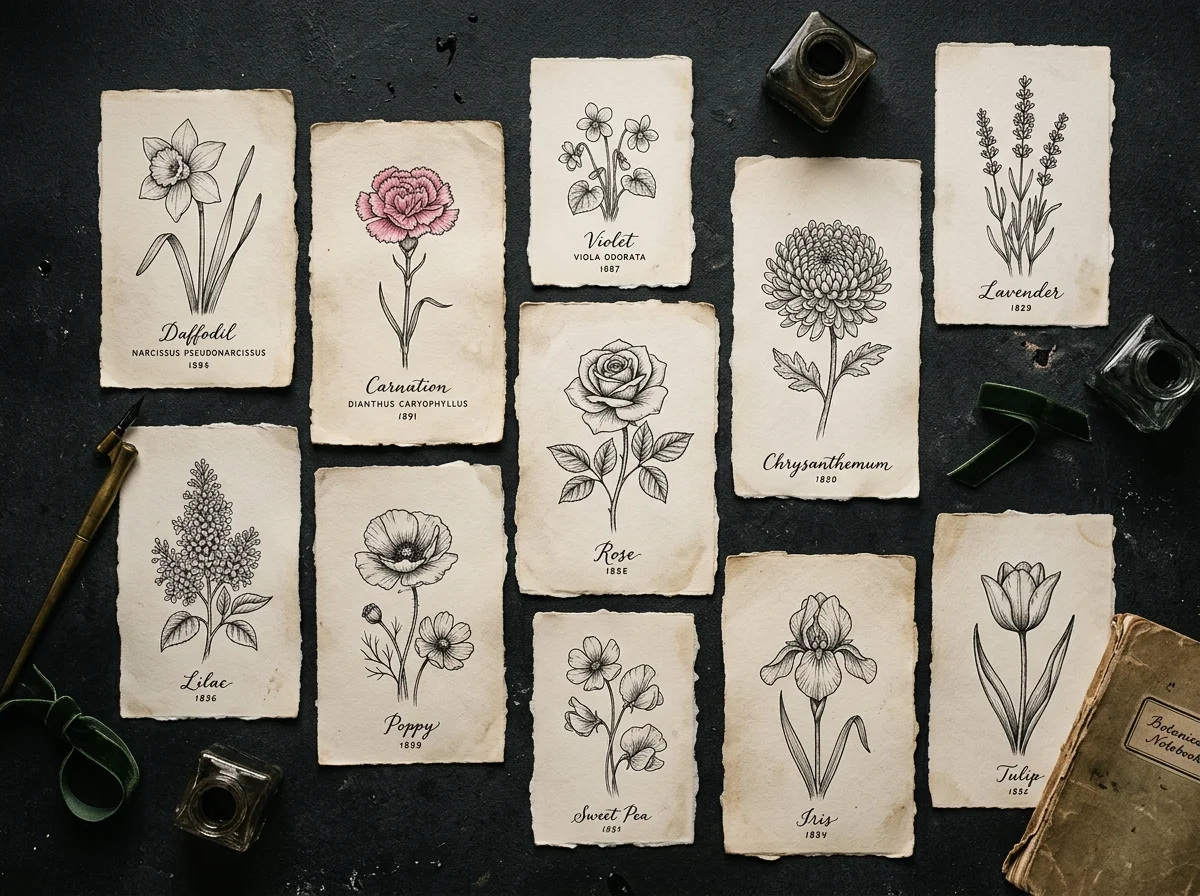
Each month offers two flowers — primary and secondary. The practical choice between them is mostly visual: which one has the line character, silhouette, and petal structure that works at your intended size and style. Here’s the full chart with notes on what makes each usable as a tattoo.
January — Snowdrop / Carnation. Snowdrop is structurally distinctive: three drooping white petals on a delicate curved stem. It renders cleanly in fine line at small scale and reads immediately. Carnation is richer with ruffled petals but needs a skilled hand to avoid visual noise at smaller sizes.
February — Violet / Primrose. Violets are small five-petaled blooms that cluster naturally — they work better in groups than as a single stem. Primrose has a rounder, more open form that reads clearly at small sizes.
March — Daffodil. One of the most structurally interesting birth flowers: the trumpet center ringed by six petals creates a silhouette that works from any angle. Currently one of the most searched birth flowers this season — distinctive enough to hold its own without being mistaken for generic floral work.
April — Sweet Pea / Daisy. Sweet pea has ruffled petals and a trailing vine that suits flowing, elongated compositions. Daisy is the most graphically simple — bold center, clear petals — which makes it easy to render but harder to make feel distinctive.
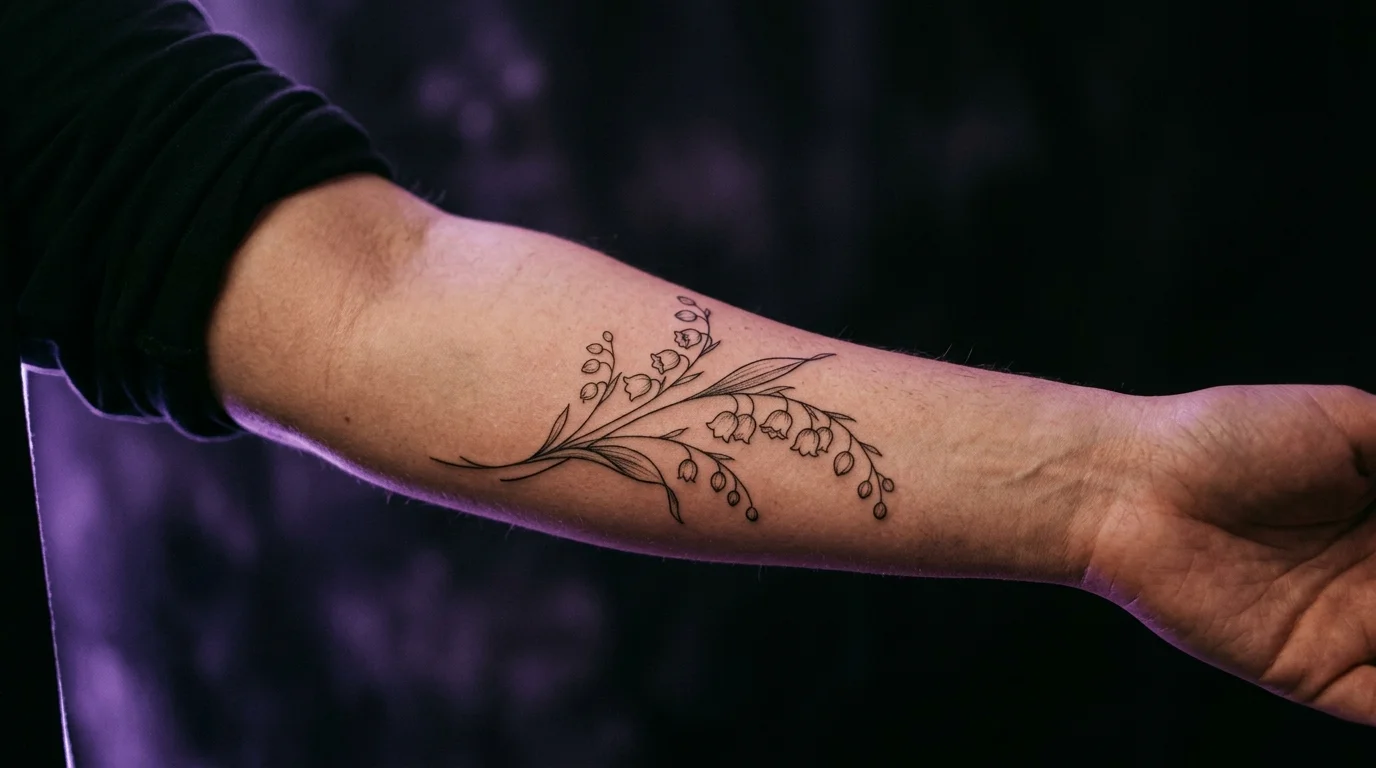
May — Lily of the Valley. Arguably the most tattooed non-rose birth flower. Small bell-shaped blooms on a curved arching stem create a composition that scales exceptionally well as a wrist or inner forearm piece. It’s delicate without looking fragile — one of the few designs that holds visual complexity at sizes under two inches.
June — Rose / Honeysuckle. The rose is the most tattooed design in the world — birth month framing adds a layer of meaning that separates it from generic rose work. Honeysuckle is the underused alternative: tubular blooms on a twining vine that works well for people who want June without a rose.
July — Water Lily / Larkspur. Water lily’s circular pad-and-bloom form creates a silhouette that looks like nothing else in the floral tattoo canon. Larkspur grows in a vertical column — tall stems with small blooms stacked up — a natural fit for narrow placements like the inner forearm or ankle.
August — Poppy / Gladiolus. Poppies are among the best birth flowers for fine line: four open petals around a dark center, clean and graphic. Gladiolus grows tall on a single stem with blooms running the length — it suits elongated placements on the calf or outer arm.
September — Aster / Morning Glory. Aster resembles a daisy but with more petals and a denser, more complex center. Morning glory is a trumpet-shaped bloom with strong graphic potential — one of the most visually distinctive September options.
October — Marigold / Cosmos. Marigold’s multi-layered petals are rich when rendered in fine line but require detail to read clearly at small scales. Cosmos is structurally simpler — six petals, a distinct circular form — easier to make feel intentional at smaller sizes.
November — Chrysanthemum / Peony. The chrysanthemum renders beautifully in both fine line and illustrative styles. It’s currently one of the fastest-rising birth flower searches — and it carries significant cultural weight across Japanese, Chinese, and Western traditions that’s worth understanding before you book. The full chrysanthemum tattoo guide covers the symbolism in detail. Peony is the bolder alternative — generous layered petals that suit medium to large scale work.
December — Holly / Narcissus. Holly is graphically strong: lobed leaves and berries that read immediately even at small sizes. Narcissus has six simple white petals and suits small-scale fine line when you want December without the holiday association of holly.
Placement Shapes What the Design Communicates
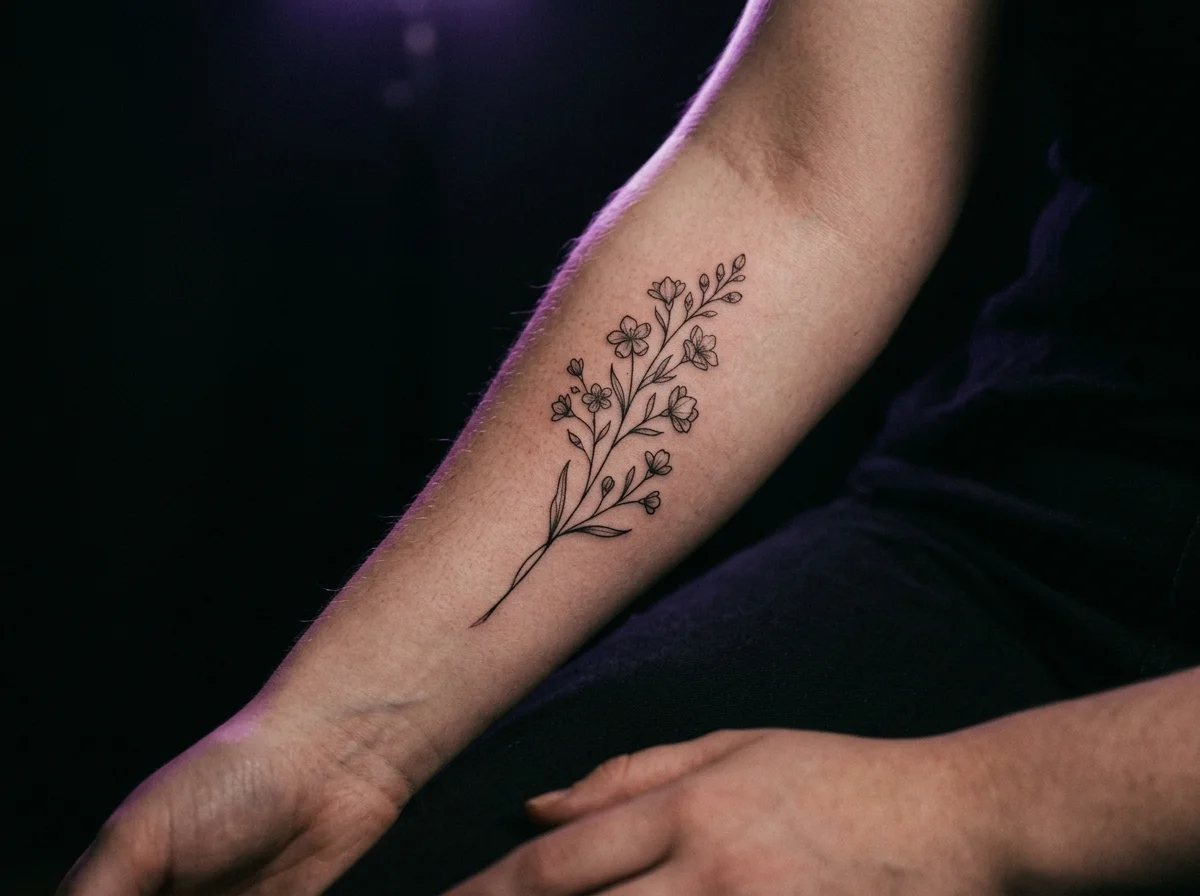
The same birth flower tattoo communicates differently depending on where it sits. Wrist placement says you want to see it. Ribs says it’s yours alone. The placement isn’t just logistical — it’s part of what the design means.
AARP’s 2024 research on tattoo motivations found that 44% of tattooed adults got tattoos to “remember or honor someone” — birth flower tattoos often serve both personal significance and memorial purposes simultaneously. Where you put it tends to reflect which of those purposes is primary.
Inner forearm and wrist are the most common choices. Fine line botanicals at this scale are immediately readable, and they face you when you extend your arm. They layer naturally if you add to the piece later.
Ankle suits smaller single-bloom designs — particularly lily of the valley, snowdrop, and larkspur, which have naturally vertical structure that suits the ankle’s narrow canvas. For ankle vs. foot considerations, the foot tattoo placement guide covers the healing tradeoffs.
Shoulder and upper back give room for more elaborate compositions: multi-stem bouquets, family pieces that combine several months’ flowers, or larger illustrative work that doesn’t read at small sizes.
Collarbone works for trailing compositions — honeysuckle, sweet pea, morning glory. These flowers naturally wind and wrap, which suits the horizontal collarbone canvas. For adjacent chest placement options, the sternum placement guide is worth reading alongside.
Fine Line Does Most of This Work — and When to Break That Rule
Fine line is the dominant style for birth flower tattoos, and for good reason. Botanical linework captures petal detail at small-to-medium scale, ages predictably, and suits the delicate visual character most birth flowers have.
But the style should match the flower’s natural visual character. Some months need something bolder.
Chrysanthemum at large scale benefits from illustrative linework — the density of petals needs weight to read clearly rather than dissolving into a wash of hairlines. Gladiolus on a calf can support illustrative or neo-traditional execution. Poppy, which has a strong graphic silhouette, works well in bold linework or single-needle pointillism. The general rule: delicate multi-petaled blooms (lily of the valley, snowdrop, violet, sweet pea) want fine line. Bold open-form flowers (poppy, gladiolus, chrysanthemum at size, marigold) have more room.
The most common mistake with birth flower tattoos isn’t the style choice — it’s the sizing. A lily of the valley that looked right on paper reads too small at the wrist. A chrysanthemum sized for the inner forearm doesn’t hold its petal detail in execution.
Birth flowers aren’t the only deeply personal design people convert into ink — pet portraits carry that same weight, and the same tradeoffs around detail and aging apply. If that’s the direction you’re considering instead, our guide to turning your pet’s photo into a tattoo covers it in depth.
Birth flowers are already personal — the design is yours by birthright. The one thing left to confirm is whether it looks right on your actual body, at actual scale, in the placement you’re imagining. That’s the gap between “this is my birth flower” and “this is my tattoo,” and it’s exactly the step most people skip. TattThat closes it: upload a photo of your wrist, forearm, ankle — wherever you’re thinking — place your design, resize until it reads right, and see how your specific flower sits against your actual skin before you book the session.
If you want to use a specific floral reference photo — a real bloom, a botanical print, or a personal image — as the starting point for your birth flower design, the photo-to-tattoo guide covers how to convert any image into something an artist can work from.
See It on Your Skin Before You Commit
Upload a photo, pick a design, and see exactly how it'll look — in seconds. 2 free previews, no card required.
Try TattThat Free →