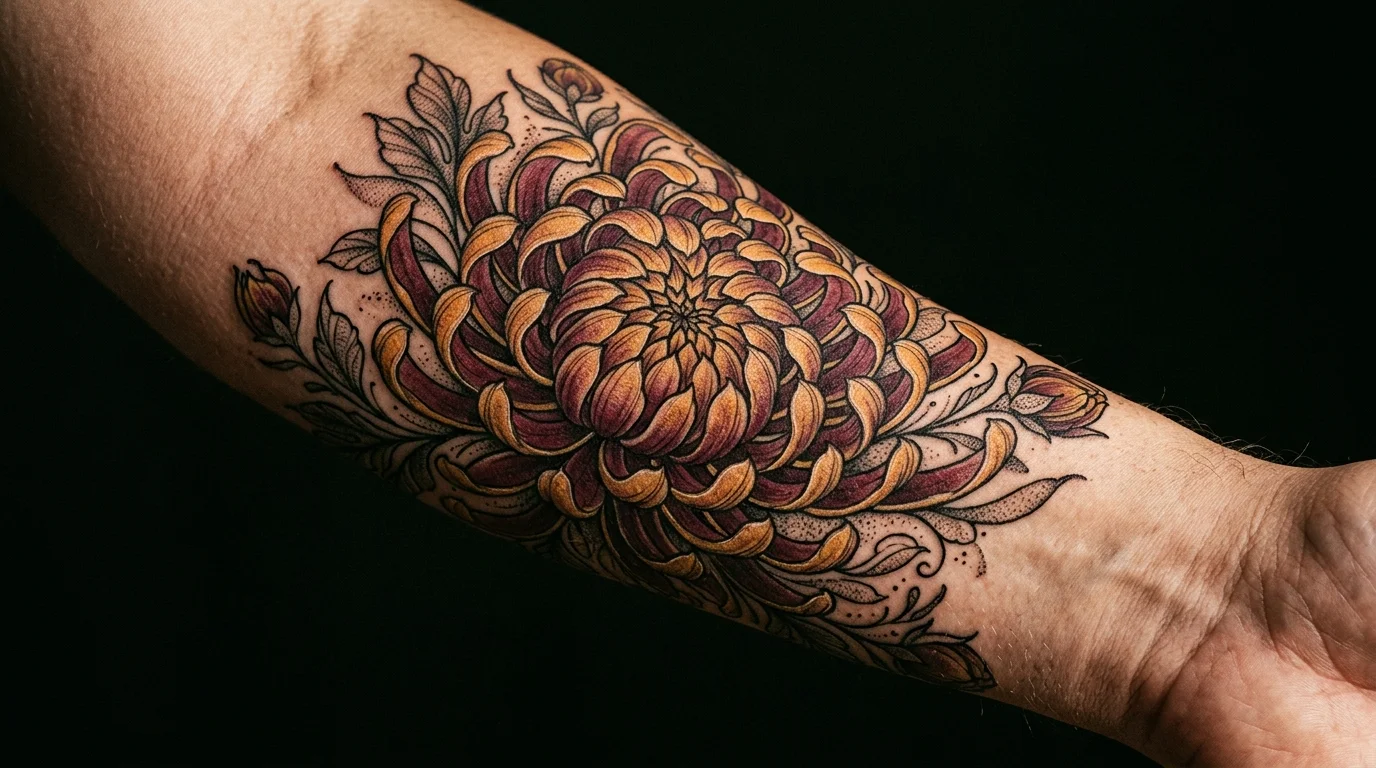
Pick up almost any modern tattoo reference gallery and you’ll find chrysanthemums. Fine-line versions on inner forearms. Neo-traditional renderings in jewel tones on upper arms. Minimalist single-stem designs on collar bones. They read as popular, beautiful, contemporary — a floral with good visual range.
Here’s the reframe: the chrysanthemum is one of the most symbolically loaded flowers in the history of tattooing. What it means shifts dramatically depending on which cultural tradition you’re drawing from. And in at least one major tradition, it’s primarily associated with death.
Most people choosing a chrysanthemum tattoo don’t know this. That’s not an argument against getting one — it’s an argument for choosing deliberately, because the design carries weight whether you intend it to or not.
The direct answer: A chrysanthemum tattoo means royalty, longevity, and protection in Japanese tradition; mourning and remembrance in Western European contexts; joy and long life in Chinese tradition. Color intensifies or shifts the meaning further. Understanding which tradition your design is drawing from — through its style, palette, and composition — is how you choose with clarity.
In Japanese Tradition, It’s a Symbol of Royalty and Protection
The chrysanthemum’s significance in Japanese tattoo culture runs deeper than most flowers. As Tattoo Life’s documentation of Japanese chrysanthemum traditions notes, the Imperial Family adopted the kiku (chrysanthemum) as their emblem, making it the most royal flower in Japanese visual culture — the Emperor’s seat is still called the Chrysanthemum Throne. Historically, chrysanthemums also served as protective talismans, particularly among people in dangerous professions like firemen, who believed the flower could ward off harm.
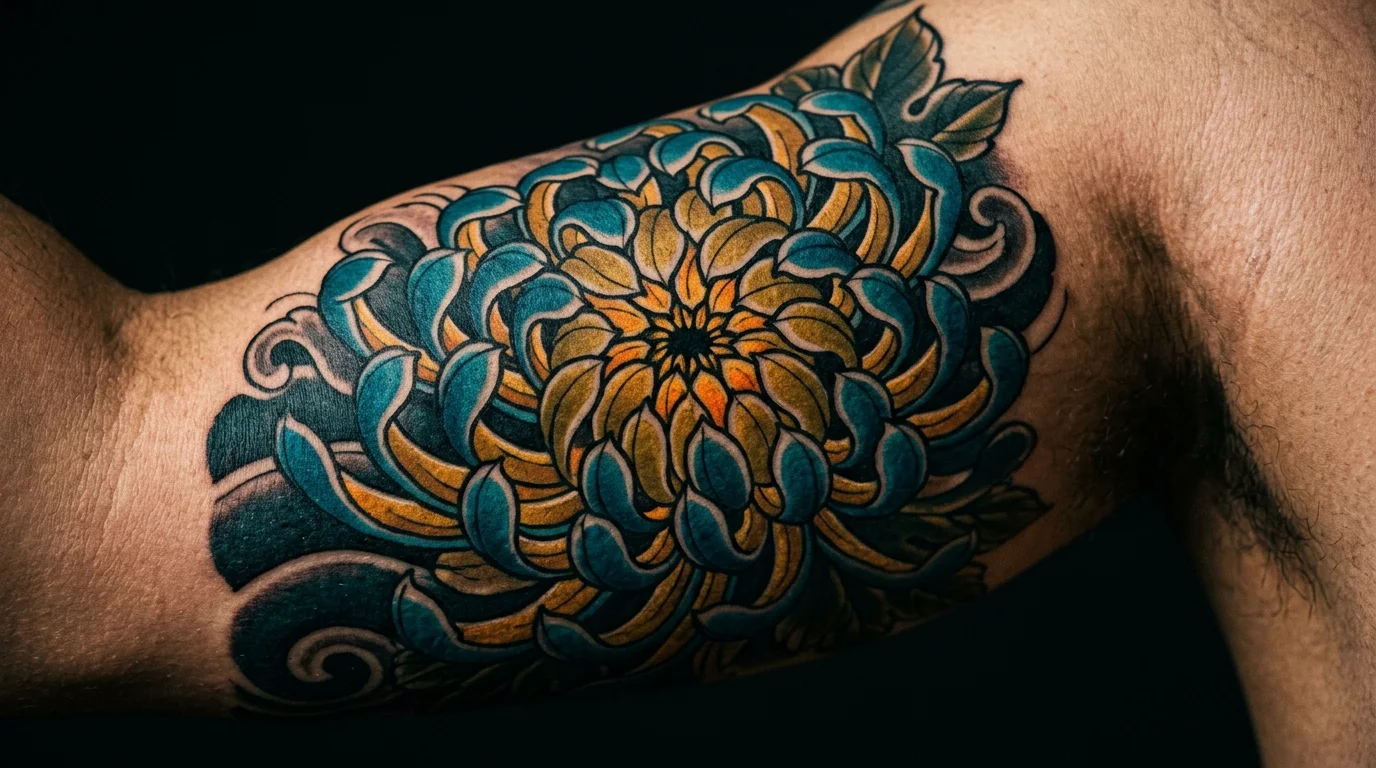
In traditional Japanese irezumi, the chrysanthemum appears as a primary motif alongside peonies, dragons, and koi. The visual vocabulary is specific: bold black outlines, stylized petal arrangements, often paired with water, wind, or other natural elements in a larger composition. The palette tends toward deep blues, teals, and golds against heavily shaded black backgrounds. This is not a delicate flower in the irezumi tradition — it’s a bold, dense, structurally confident design.
The cultural weight matters. If you’re drawing a chrysanthemum in an irezumi-adjacent style, you’re invoking a centuries-old symbolic language. That’s not a liability — it’s a reason to research the tradition you’re entering, and potentially to find an artist who works specifically in that lineage rather than a generalist who can execute a similar-looking piece.
Longevity is the core symbolic thread across Japanese and Chinese chrysanthemum culture. The Chinese associated the flower with long life and good fortune in the home; Japanese court culture used it in autumn harvest rituals celebrating the turning of the season and the continuity of the imperial line. In both traditions, the chrysanthemum faces and endures — it blooms late in the year, when other flowers have gone, which is precisely why it became a symbol of persistence.
In Western Contexts, It’s Primarily a Flower of Mourning
This is the cultural fact most people skip, and it’s worth sitting with before booking.
In France, Belgium, and much of Southern Europe, chrysanthemums are specifically associated with funerals and gravesites. You bring chrysanthemums to cemeteries on All Saints’ Day. Gifting them in other contexts is considered bad taste in many parts of Europe — the association with death and mourning is that strong.
In American tattoo culture, the mourning connection is softer but still present. Memorial tattoos — honoring someone who has died — frequently incorporate chrysanthemums for exactly this reason. The flower is a beautiful, culturally legible way to say: this design exists in honor of someone I’ve lost.
None of this makes a chrysanthemum tattoo morbid or wrong. Memorial tattoos are among the most meaningful pieces people get, and research consistently shows that tattoos tied to honoring others are among the most satisfying long-term. The 2024 AARP survey of 3,076 adults found that 75% of tattooed people are completely satisfied with their ink, and that honoring someone was the most commonly cited meaningful reason — 44% of respondents.
The point is simply this: if you’re choosing a chrysanthemum for its pure aesthetic quality, with no intent toward the mourning or memorial tradition, the design still carries those associations in certain cultural contexts. Knowing that lets you decide consciously — whether to lean into the memorial meaning, research the Japanese tradition instead, or simply know what you’re carrying.
Color, Style, and What Actually Fits Your Body
The chrysanthemum is compositionally versatile in a way few flowers are — its layered, radially symmetric petal structure works in bold irezumi, fine line botanical, neo-traditional illustrative, and minimalist single-line styles. The style you choose is the clearest signal of which cultural tradition you’re drawing from, and it determines the aging profile and placement requirements.
Japanese irezumi style: Bold, structured, dense. Needs room — upper arm, thigh, back panels, chest. Ages exceptionally well because of the structural line weight. Color in traditional blues, teals, and golds holds longer than pastel fills. This is the style where the chrysanthemum’s imperial symbolism is most legible.
Neo-traditional: Rich color, illustrative shading, Art Nouveau compositional influence. Jewel tones (burgundy, deep gold, emerald) read beautifully and age better than lighter fills. Works across most placements. The full neo-traditional guide covers what makes this style hold over time and what to look for in an artist.
Fine-line botanical: Contemporary, precise, minimal. Black-and-grey versions age best — fine white ink without anchor lines fades quickly. Popular on inner forearms, clavicles, shoulder blades. Requires a fine-line specialist. Visually lighter — the cultural weight of the Japanese tradition is largely absent in this style, which can be exactly what you want.
Color considerations: White chrysanthemums carry mourning resonance in Japanese and European traditions; in tattoo form, fine white ink is also the quickest to fade without strong black backing. Deep burgundy, rich gold, and saturated pink hold color better and read as vitality rather than memorial. Black-and-grey avoids the color question entirely and ages reliably across placements.
Tattoos built around personal meaning show the highest long-term satisfaction — studies on tattoo psychology find that when people get work tied to genuine identity rather than trend appeal, they report less dissatisfaction over time. The chrysanthemum’s symbolic depth is an asset if you understand it, not a liability.
Seeing It on Your Body Before You Commit
Chrysanthemums are visually complex — layered petals, potential color work, size-dependent detail. What looks proportionally right on someone else’s forearm in a reference photo may need to scale differently on yours. A bold irezumi chrysanthemum that reads powerfully on an upper arm might be overwhelming at that size on a smaller canvas; a fine-line botanical that seems delicate in the reference image might need to be larger than you’re picturing to hold its detail.
TattThat lets you upload a photo, place the design at your actual placement, and see how the specific piece — scale, composition, color — reads on your skin before any appointment. The “is this the right size, does this placement work for this design” anxiety that builds before booking a complex piece is what it closes.
If you’re still working out which style fits the chrysanthemum design you have in mind, the tattoo style guide covers how botanical motifs translate across fine line, watercolor, blackwork, and neo-traditional.
See It on Your Skin Before You Commit
Upload a photo, pick a design, and see exactly how it'll look — in seconds. 2 free previews, no card required.
Try TattThat Free →