You’re at the consultation. Two reference images on your phone. The first is fine line — delicate, botanical, precise. Beautiful. But somehow too quiet for what you’re actually trying to say. The second is American Traditional — bold, unmistakable, structurally timeless. But something about it reads as belonging to someone else’s relationship with permanence. A language you admire but don’t quite speak.
You keep scrolling. And then you find a third image — the one you couldn’t immediately categorize. Rich color. But structured. Illustrative without being chaotic. Bold enough to hold, delicate enough to breathe. Something in your chest relaxes slightly. That’s the one.
That’s neo-traditional. And the fact that it took you a moment to name it is exactly why it’s worth understanding before you book.
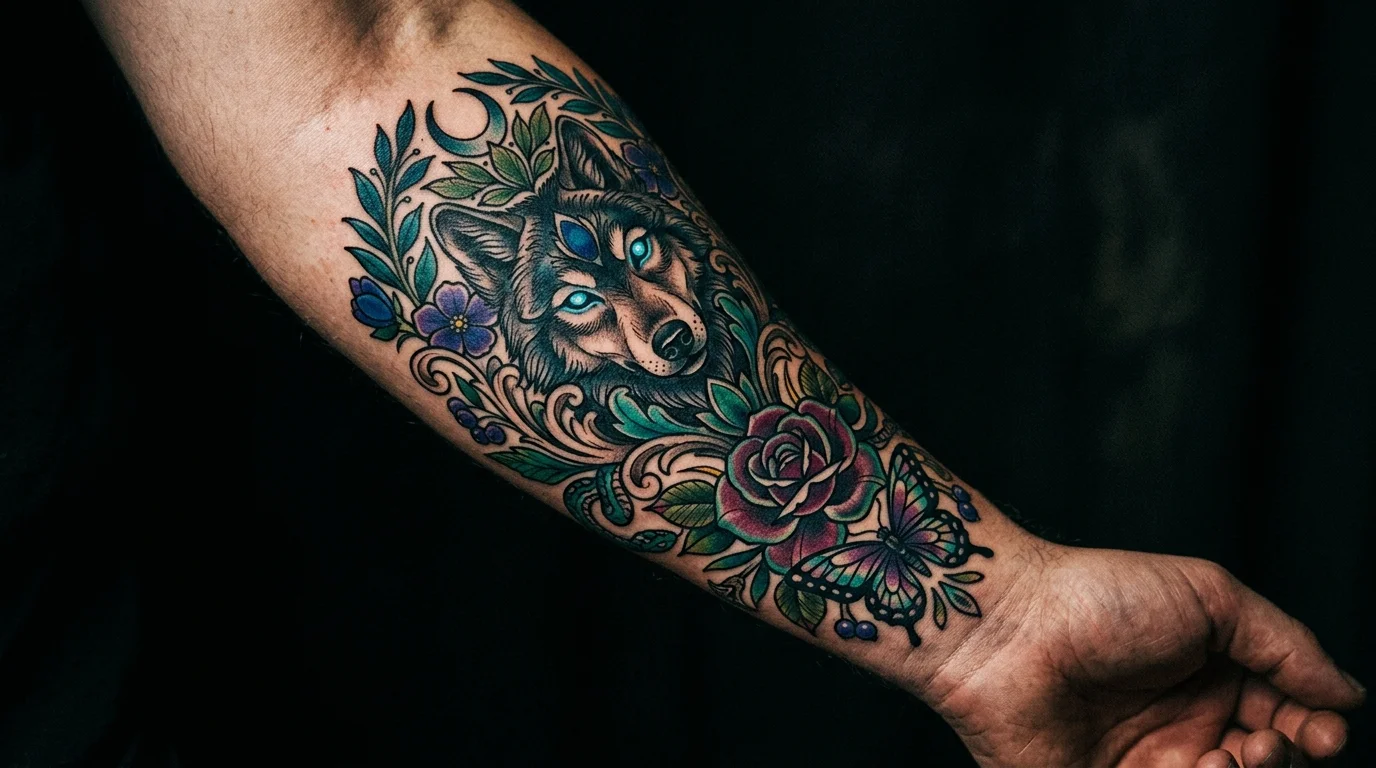
What neo-traditional actually is: Neo-traditional tattoos take American Traditional’s defining structural element — the bold black outline — and open it up. Richer color palettes. More illustrative shading. A subject range that extends well beyond Old School’s classic iconography into Art Nouveau and Art Deco aesthetics: natural motifs treated with jewel-like density, animals and botanicals rendered with both precision and warmth, figures set against elaborate organic backgrounds. The outline is still there. It’s still load-bearing. But everything inside it has room to breathe and evolve.
Traditional’s Bones Make This Style More Durable Than It Looks
The key structural fact about neo-traditional — the one most people miss when weighing it against fine line — is that the bold black outline isn’t decoration. It’s the reason the design holds over decades.
Every tattoo experiences some degree of fading and ink dispersal as the dermis settles over time. UV radiation accelerates the fading of colored tattoo pigment — a real, measurable process, not just conventional wisdom. Fine line tattoos have almost no structural buffer against it. Hairline strokes lose definition as ink spreads through the skin; the design softens, blurs, and eventually needs touch-up work to read correctly.
Neo-traditional’s outlines give the design a skeleton it keeps at year one and year fifteen. The colors inside may soften — they will, over time, especially on sun-exposed placements without sunscreen — but the design doesn’t lose its form the way fine line does. There’s architecture underneath the color, and that architecture is what you’re actually committing to.
One detail worth knowing before you finalize your design: lighter colors fade faster than saturated jewel tones. Pastels, yellows, and pinks will lose vibrancy ahead of the deep blues, greens, and purples that define the style’s richest work. The best neo-traditional artists build with this in mind — heavier ink in the mid-tones, bright highlights used economically rather than as primary fills. When you’re evaluating portfolios, look specifically at healed work. Fresh neo-trad looks striking in almost everyone’s hands. Healed photos at six months to a year show you who actually built the design to last.
What “Illustrative” Actually Means on Skin
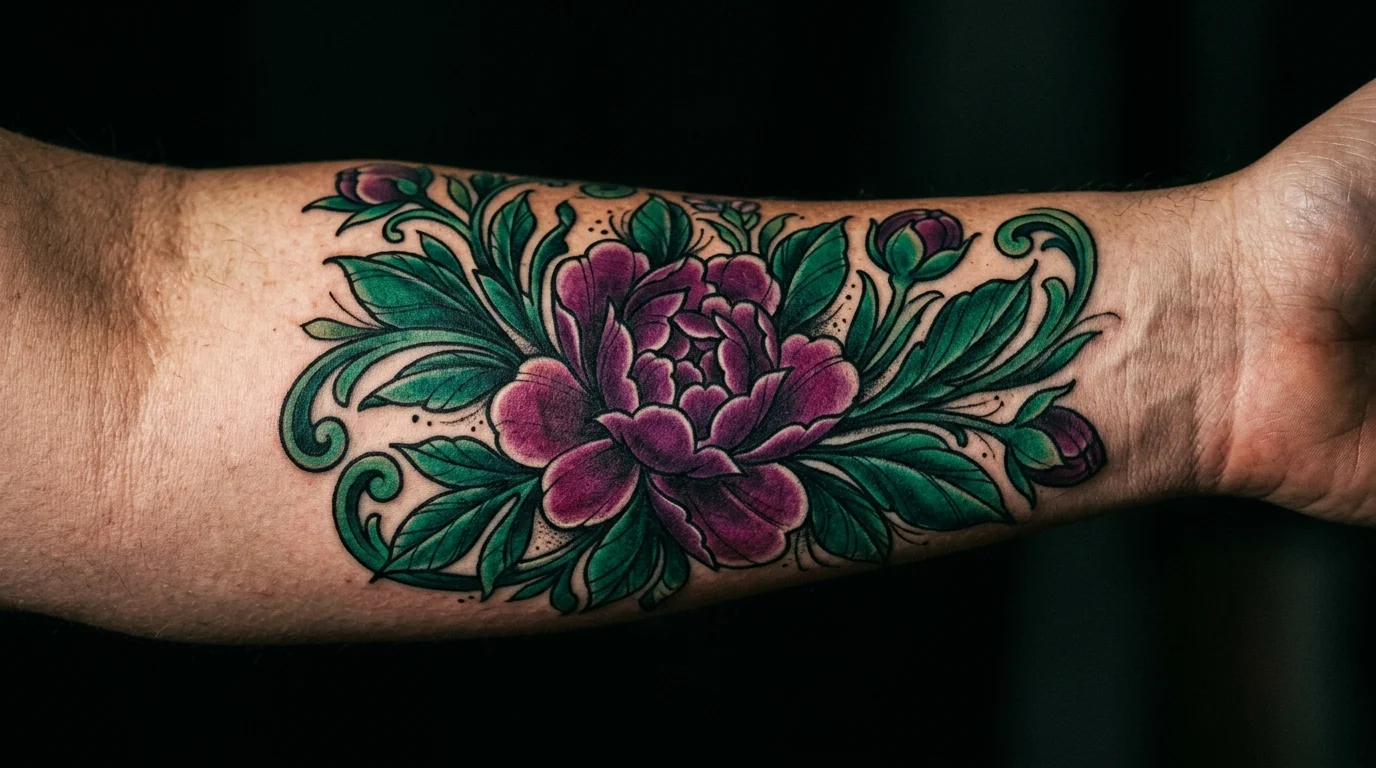
Tattoodo’s style guide on neo-traditional describes the best work in the style as built around “brilliant and dramatic colors” and a “dense and richly sumptuous aesthetic” drawn from Art Nouveau and Art Deco traditions. Understanding those influences helps you evaluate portfolios and communicate with artists.
Art Nouveau aesthetics: organic, flowing lines, natural subjects (flowers, animals, figures) treated with a decorative sensibility rather than a literal one. The botanicals curve and fill space with intention. Art Deco aesthetics: symmetry, geometric structure underneath organic forms, a sense of compression and richness. The best neo-traditional work draws from both — a predator portrait that has geometric organization, or a floral composition that has architectural depth.
This matters practically because it explains what separates neo-traditional from simply “a colorful tattoo with outlines.” The illustrative quality isn’t about adding detail — it’s about how the detail is organized and layered. A skilled neo-trad artist thinks about how the eye moves through the composition, how color temperature creates depth, and how the botanical elements relate to each other on the body. That thinking shows in healed work and is absent in the work of artists doing neo-trad by surface aesthetic alone.
Common subject matter that works especially well in the style: animal portraits (foxes, ravens, serpents, wolves), florals and botanicals (roses, peonies, chrysanthemums), ornamental compositions mixing natural subjects with filigree or pearls, and female figures treated in an Art Nouveau register. The style handles almost any subject — the question is whether your artist’s portfolio shows the illustrative vocabulary to pull it off.
Where Neo-Traditional Lives Best on the Body
Neo-traditional works across a wider range of placements than most color-heavy styles, largely because the bold outline structure holds even under conditions that would degrade fine line or watercolor work.
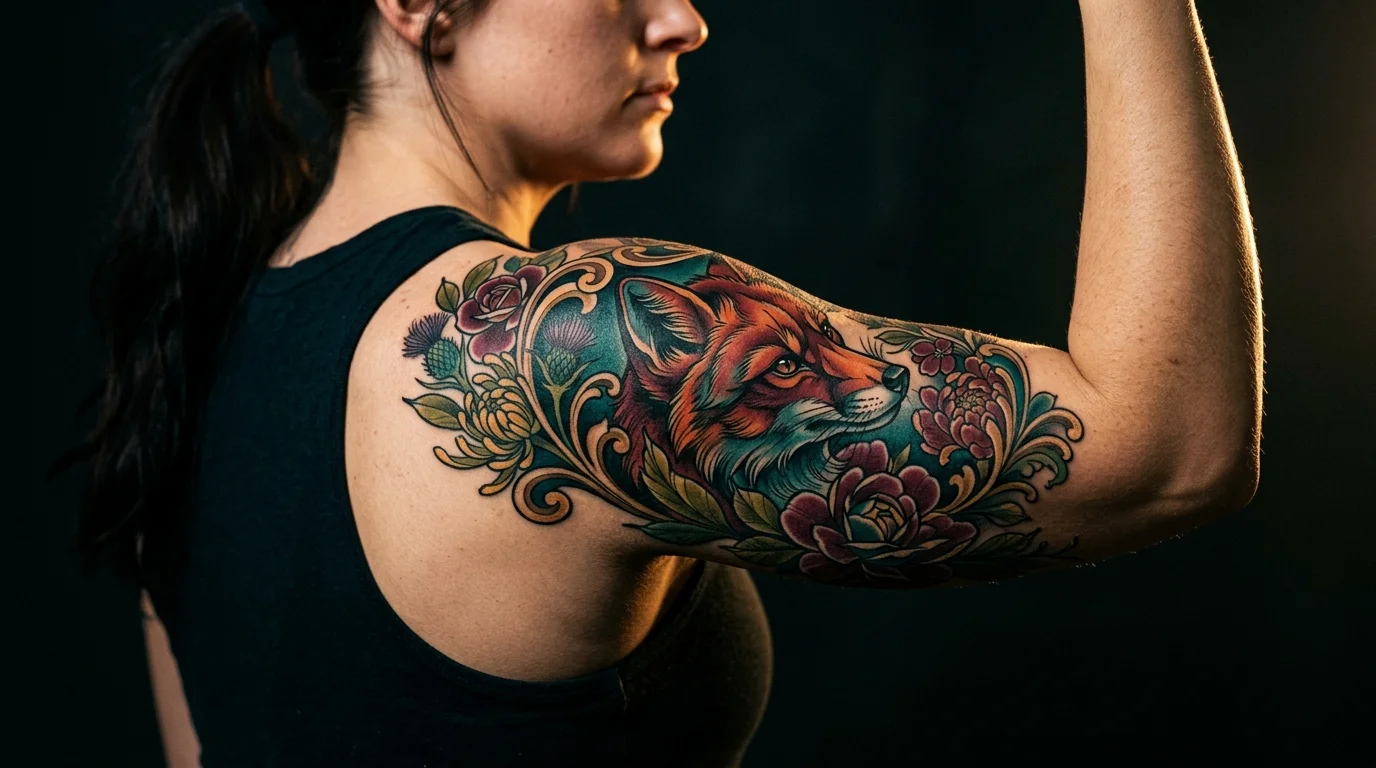
The style suits curved surfaces particularly well. The illustrative quality — the way good neo-trad fills space organically rather than geometrically — wraps naturally around biceps, ribs, thighs, and the chest. A neo-trad botanical sleeve or a predator portrait on the upper arm uses the body’s contour as part of the composition, not a problem to work around.
For sun-exposed placements like the outer forearm or shoulder: consistent SPF protection is what keeps the color rich. The outline holds regardless; the jewel-tone saturation is what you’re protecting. This isn’t an argument against those placements — it’s a habit to build before the ink is six months old, not after you notice fading.
Scale is more critical in this style than in simpler ones. The color layering, botanical density, and illustrative depth that define neo-traditional need room to breathe. A two-inch piece can work, but the style earns its full visual impact at four inches or above. If you’re thinking small, discuss it with your artist before finalizing the design — some compositions scale down cleanly; others lose their defining richness when compressed.
For a detailed breakdown of how placement interacts with any tattoo style’s longevity, the complete tattoo placement guide covers every major location with design and aging tradeoffs. And if you’re deciding between the shoulder area and other options, the shoulder tattoo guide breaks down what fits each zone.
Finding the Right Artist for This Style
Neo-traditional is a specialist style. That’s not a discouraging note — it’s a clarifying one. Research into tattoo motivation consistently finds that identity and personal expression are the primary drivers — people get tattooed as a way of making their body their story. The choice of who creates that permanent expression is where the most important decision lives.
A competent general tattoo artist who doesn’t specialize in neo-trad will produce a competent result — not the layered color depth, Art Nouveau-influenced composition, and jewel-tone saturation that makes the style what it is. Those qualities require a practitioner who has spent time specifically in this visual language.
What to look for when evaluating portfolios:
Healed work, not just fresh. Ask for it explicitly. Many artists post only fresh tattoos, which look sharp under almost any execution. Healed photos at six months or more show you how the color holds, how the outlines age, and whether the design retains its illustrative richness.
Jewel tones that read as distinct. Saturated blues, greens, and purples should hold their own character in the composition — not blend into a muddy mid-range. If the color work in a portfolio looks unified but indistinct, the artist may not be managing color temperature and layering at the level the style demands.
Art Nouveau organization. The best neo-trad artists think in terms of how botanical and natural elements compose on the body’s surface. Florals should feel intentional, not decorative filler. Portraits should have the illustrative quality that distinguishes the style from realism.
A specific opinion in the consultation. Any artist serious about their neo-trad work will push back on or refine what you bring in. If the consultation is purely transactional — “yes, I can do that, here’s the deposit” — that’s information about how much the artist is actually engaged with the style.
The Question Nobody Asks Before the Appointment
Style anxiety in neo-traditional is specific: this is a bold, color-rich, illustrative style, and the gap between “I love this in someone else’s reference photo” and “this works on my proportions, at my scale, at my placement” is real. A fox portrait that reads perfectly on another person’s upper arm — dense, jewel-toned, with botanical surround — might need to scale differently on yours. The composition might want to wrap differently.
TattThat lets you upload a photo, place the design at your actual placement, and see how a neo-trad piece reads on your skin and proportions before any appointment is made. That “will this style suit me specifically” question — not will I like neo-trad in general, but will this design, at this size, in this placement, look the way I need it to — is exactly what it answers. See the style on your body before you commit to it.
If neo-traditional is one of several styles you’re weighing, the tattoo style guide covers the full comparison — fine line, blackwork, realism, and where neo-traditional fits among them.
See It on Your Skin Before You Commit
Upload a photo, pick a design, and see exactly how it'll look — in seconds. 2 free previews, no card required.
Try TattThat Free →