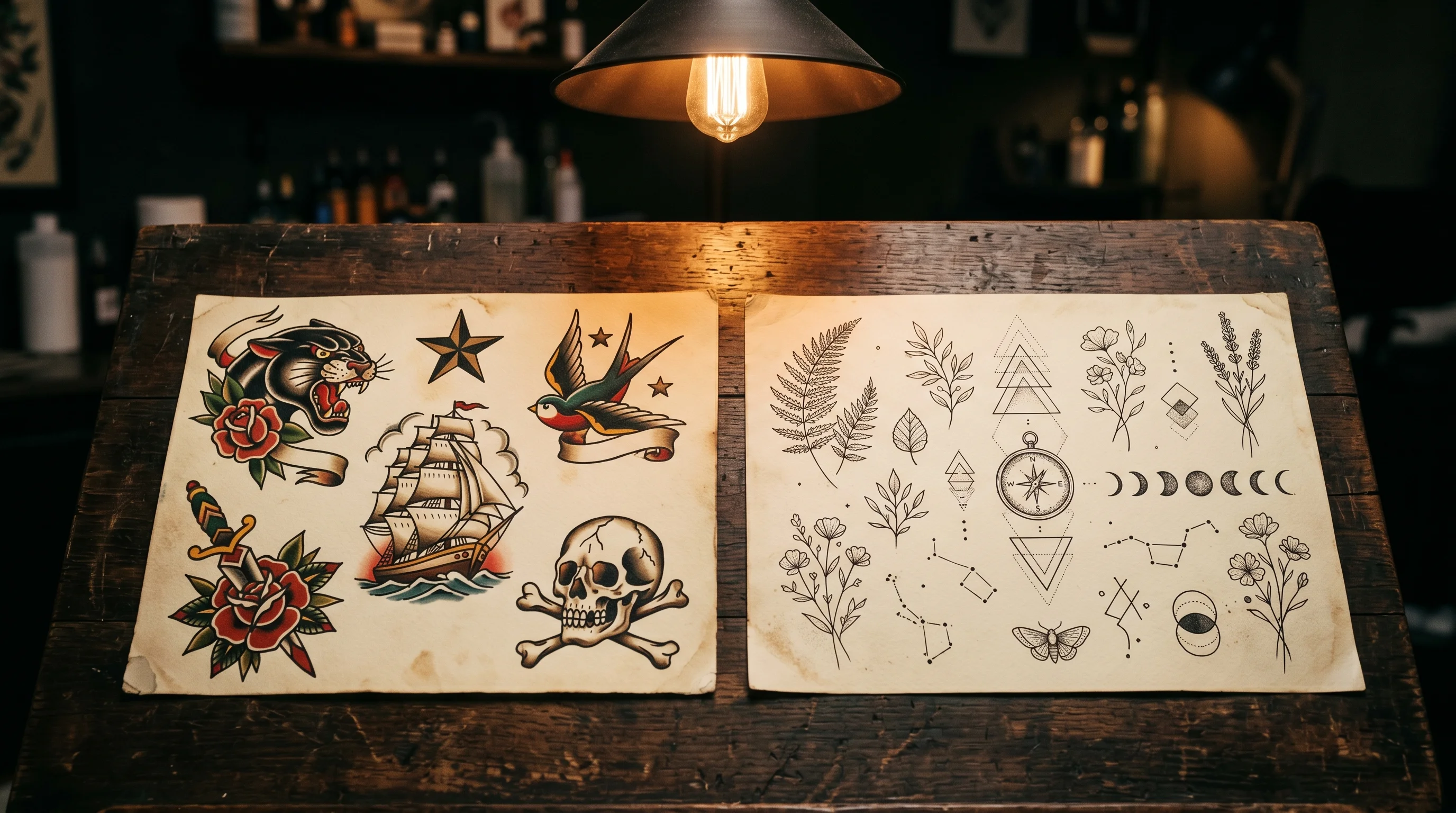
Which one will still look good in ten years?
That’s the question under every comparison between minimalist and traditional tattoo styles. Not which looks better in the Instagram photo from right after the session — they both can. The real question is what you’re looking at when you’re forty, fifty, sixty: a piece that still reads the way it was meant to, or something that’s softened past recognition.
The answer isn’t the same for both styles. And the conditions that determine outcome for each are completely different.
The direct answer: Traditional tattoos are structurally engineered to age well — thick lines, high contrast, ink depth. Minimalist tattoos can age beautifully, but they require specific placement, a specialist artist, and consistent aftercare. The gap between a well-executed minimalist piece at fifteen years and a poorly-executed one isn’t aesthetic — it’s whether it’s still legible.
Traditional Is Built to Last. That’s Not an Accident.
American traditional tattooing — the bold outlines, the limited solid color palette, the flat fills — didn’t develop that way purely for aesthetic reasons. It developed over a century of artists learning what survives on skin long-term and encoding that knowledge into a style.
The structural rules of traditional tattooing are specifically longevity-optimized. Thick black outlines maintain definition as ink settles and skin changes with age. High-contrast fills (solid black against clean color) resist the blurring that hits fine detail first. Limited color palettes stay legible even as pigment fades, because the design doesn’t depend on subtle color gradients that disappear at the two-year mark.
A 2025 YouGov survey found that 76% of Americans now consider tattoo design an art form — up from 65% a decade ago. Part of what’s driven that cultural shift is seeing well-aged traditional work: pieces twenty, thirty years old that still carry their intent. That durability isn’t luck. It’s the structural vocabulary of the style working the way it was designed to.
Traditional isn’t aging-proof — placement matters here too, and sun exposure degrades any ink over time. But it has a wide margin for error. A traditional piece on a moderately sun-exposed forearm with average aftercare still looks like itself a decade later. A fine-line piece in the same conditions may not.
Minimalist Tattoos Require More Specific Conditions
Minimalist and fine-line work isn’t fragile because it’s poorly made. It’s more demanding because the aesthetic is defined by what isn’t there — negative space, single-needle lines, subtle shading. The moment those thin lines soften or spread slightly, the design loses the precision that defines it.
According to Certified Tattoo Studios, traditional styles deposit ink deep in the dermis, below the body’s natural cell turnover zone. Fine-line work sits closer to the skin’s surface, which means it has less protection from the body’s own regeneration processes — and more vulnerability to sun exposure, friction, and moisture.
This doesn’t mean fine-line fades and traditional doesn’t. It means fine-line’s margin is narrower:
- Sun exposure accelerates fading in any ink, but thin lines lose clarity faster than thick ones — there’s less ink to work with when degradation starts.
- Placement friction blurs fine-line work more quickly. Fingers, inner wrists, and ankles face constant skin-on-skin or skin-on-fabric movement that traditional’s thick lines can tolerate but fine-line cannot.
- Artist experience is a larger variable in fine-line than in traditional. An experienced fine-line specialist has seen their own work healed at two, five, and ten years. They’ve adjusted their technique accordingly. A newer artist working in fine-line hasn’t accumulated that feedback yet.
Regret research shows that technical quality and aging poorly rank among the top reasons people regret their tattoos — cited by roughly 41% of those with regret. For minimalist work, that risk is concentrated specifically in the artist-selection decision in a way that traditional work, with its larger margin for error, is not.
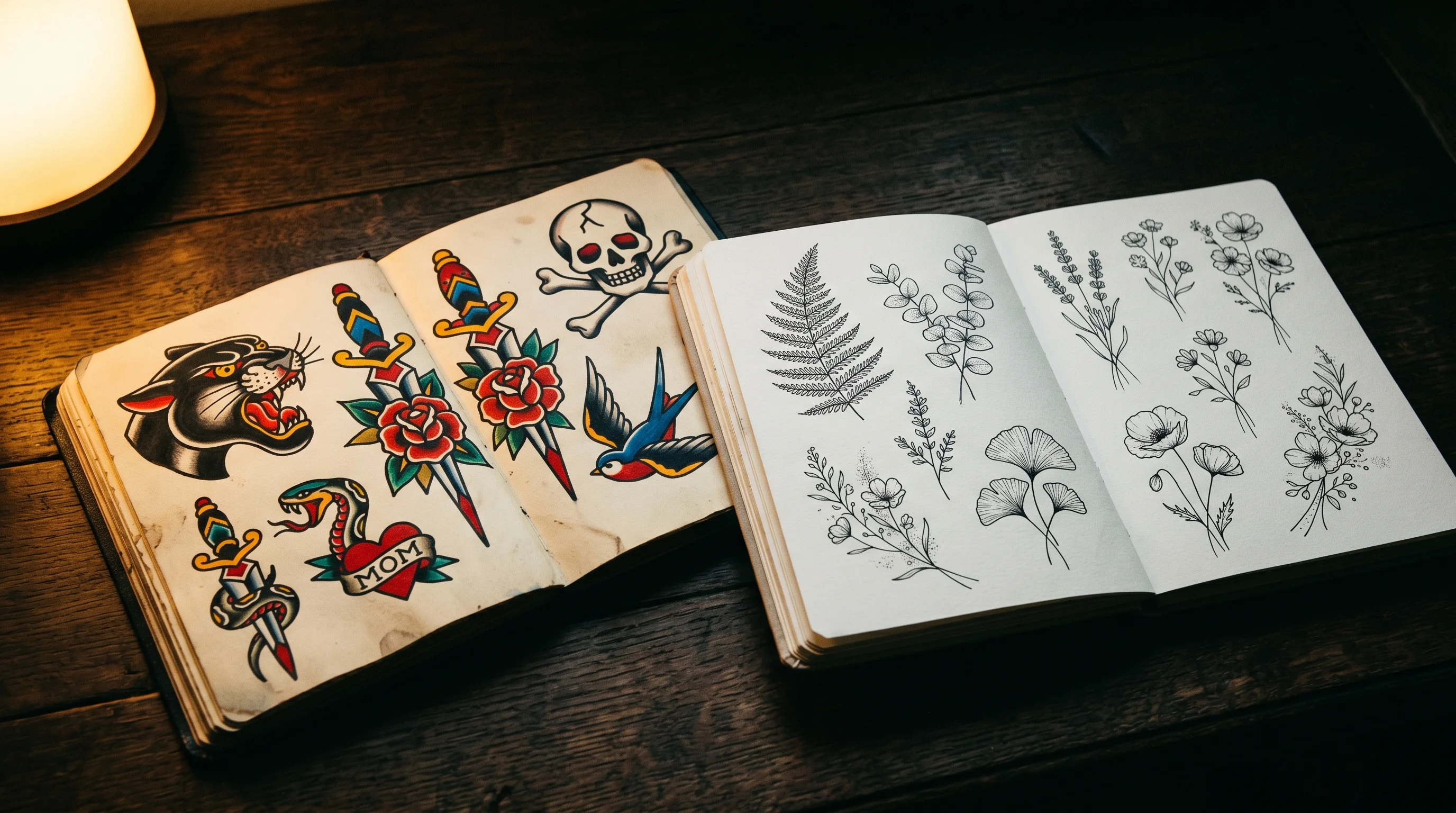
When Minimalist Ages Beautifully
Fine-line and minimalist tattoos aren’t a gamble — they’re a discipline. The conditions that make them age well are knowable. Here they are:
Placement matters more than in any other style. Upper arm, outer forearm, shoulder blade, calf, and rib cage consistently hold fine-line work well. Inner forearm and upper back hold moderately well with sun protection. Avoid fingers, inner wrists, feet, and ankles — high friction and movement create blurring that fine-line can’t withstand the way traditional does.
Artist specialization is non-negotiable. A fine-line specialist who has done two hundred pieces in the style has calibrated their line weights, their ink depth, their understanding of how their specific work ages. Ask to see healed examples specifically. Not fresh-session shots. Healed work is the truth.
Sun protection extends the life dramatically. Ipsos data shows that 92% of tattooed Americans are happy with their decision to get inked — and the people who report the highest long-term satisfaction are those who maintained their ink through aftercare. For fine-line, SPF on exposed placements isn’t optional maintenance. It’s the variable between a crisp piece at ten years and a faded one at five.
Slightly bolder than you picture it. This is counterintuitive, but experienced fine-line artists often recommend going slightly heavier on line weight than the reference images that inspire the piece. The version in the reference photo was fresh. Yours will live on skin for decades. A fraction more ink depth gives the design structural integrity without changing its visual character.
The Honest Versus
| Traditional | Minimalist / Fine Line | |
|---|---|---|
| Longevity | Engineered for it | Conditional on placement, artist, care |
| Best placements | Forgiving across most | Upper arm, shoulder blade, outer forearm, calf |
| Worst placements | Face, fingers, neck | Fingers, inner wrist, ankle, foot |
| Sun sensitivity | High, but structurally tolerant | High, and structurally less tolerant |
| Artist specialization | Important | Critical |
| Regret risk | ~29% among those who experience regret | Design-dependent; higher for text/quote variants |
| Touch-up needs | Low to moderate | Moderate to high, depending on placement |
Neither style is wrong. They produce entirely different results and require different conditions to look their best long-term. What changes the outcome is knowing which conditions apply to your idea, your placement, and your artist.
Seeing Both Styles on Your Body Before You Commit
The comparison above tells you the rules. What it can’t tell you is what your specific design looks like in each style on your specific body — at the scale you’re picturing, on the placement you have in mind, with your proportions.
That’s the gap TattThat closes. Upload a photo, apply your reference design, and see exactly how it reads on your skin before any booking. The difference between a bold traditional rendition of your idea and a minimalist fine-line version of the same concept is dramatic — and it’s one you can evaluate on your actual body, at your actual placement, before you’re committed to either.
The “which style is right for me” question that you’re currently answering from Instagram references gets a much clearer answer when you’re looking at it on yourself. That’s the version that matters.
For more on how specific styles age and what to look for in an artist working in your chosen style, the full tattoo style guide covers the complete spectrum — including fine-line, blackwork, realism, and how each ages by placement. If you’re considering going all-black, the blackwork guide covers why it’s actually the best-aging style and what separates the subgenres. And if you’ve already decided on fine-line, the fine-line tattoo aging guide goes deep on exactly what to expect and how to protect it.
See It on Your Skin Before You Commit
Upload a photo, pick a design, and see exactly how it'll look — in seconds. 2 free previews, no card required.
Try TattThat Free →