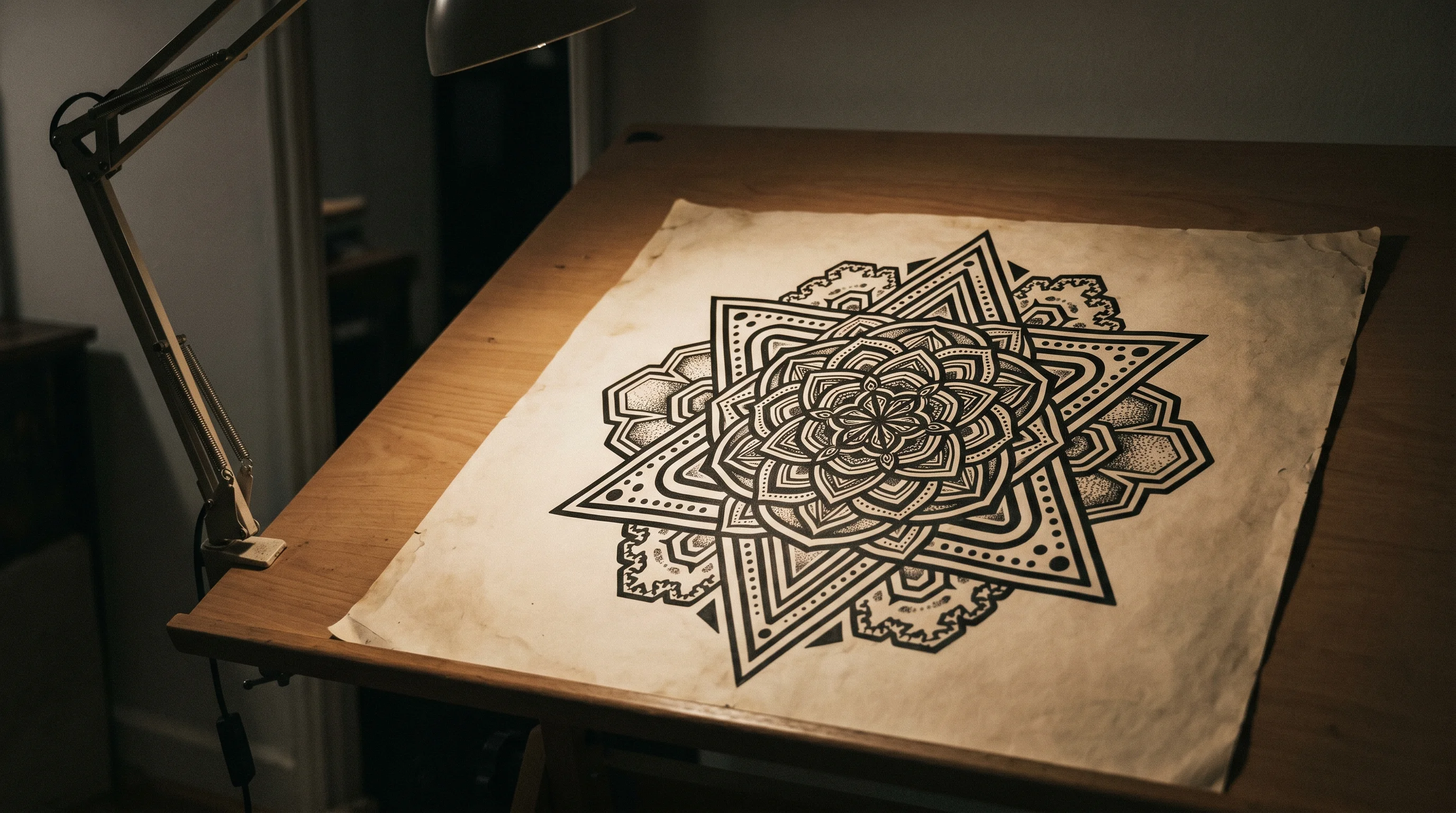
Picture the tattoo you’re about to get, ten years from now. Not faded — settled. The solid fills have deepened into the skin. The edges that looked almost too sharp at one year have softened just enough to feel embedded rather than applied. The piece has stopped looking like a tattoo and started looking like part of you.
That’s not a sales pitch for blackwork. It’s what high-ink-volume tattooing actually does over time, and it’s why people who’ve had blackwork for a decade almost universally describe it as looking better than when it was fresh.
The direct answer: Blackwork is any tattoo executed in black ink only — no color, no grey wash. It encompasses tribal and Polynesian patterns, geometric and sacred geometry, illustrative dark art, and bold botanical work. It ages better than almost any style because solid fills and thick lines have the most ink volume, giving the most structural resilience over time. The trade-off is commitment: large blackwork takes longer, covers more skin, and requires a specialist.
What Blackwork Actually Is (and What It Isn’t)
Blackwork is not a single aesthetic — it’s a technical category defined by one constraint: black ink only. That constraint produces a surprisingly wide range of results.
According to Tattoodo’s blackwork style guide, the category spans tribal and Polynesian patterns with bold solid fills, sacred geometry using precise geometric lines and shapes, dark illustrative art with heavy shading, graphic and etching-style linework, and calligraphic scripts. The visual difference between a fine-line botanical in black ink and a dense Polynesian tribal chest piece is enormous — but technically both are blackwork.
What they share: no color, typically high contrast between solid black and untattooed skin, and a reliance on the interplay between filled areas and negative space (the skin itself becomes part of the design).
What blackwork is not: black-and-grey tattoos. Black-and-grey uses diluted black ink washes to create tonal shading and gradients — it’s a distinct style with different aging characteristics. Blackwork is typically flat and graphic rather than three-dimensionally shaded.
Why Blackwork Ages Better Than Almost Any Style
Tattoo aging is fundamentally a story about ink volume and UV exposure. The more ink deposited per square millimeter, the more resilience against the forces that degrade it over time.
Blackwork typically uses more ink than any other style. Solid black fills — especially the heavy coverage areas in tribal, geometric, and dark art blackwork — deposit ink throughout the entire area of skin, not just in lines. When UV radiation starts breaking down pigment molecules, bold-filled areas have an enormous buffer. When ink particles migrate slightly in the dermis over years (which happens in every tattoo), solid fills absorb the change invisibly. When skin texture shifts with age, the density of the ink maintains legibility.
This is why a well-executed blackwork piece at fifteen years often looks more refined than it did fresh. At one year, the edges are still slightly raised, the contrast stark, the fills solid. At fifteen, the ink has fully integrated, the edges have softened fractionally into the skin, and the design looks genuinely part of the person wearing it — not applied.
The corollary: precise fine-line blackwork (spiderwebs, intricate geometrics with thin lines) has less of this advantage than bold-fill blackwork. A design that’s mostly thin lines without fills ages more like fine-line work — still well compared to color, but more dependent on placement and artist technique than a bold-fill piece would be.
The Subgenres: Which One Matches Your Idea
Knowing these categories helps you find the right artist — because specialists diverge significantly:
Geometric / sacred geometry: Precise linework forming mandalas, tessellations, dotwork grids, and mathematical patterns. Can be entirely linework or incorporate solid fills. Requires an artist with technical precision — the geometry is unforgiving of wobbles or inconsistency. Ages well when executed with appropriate line weight.
Tribal / Polynesian: Bold, culturally-rooted patterns using solid fills and thick outlines, often designed to wrap the body’s contours. Best aging of all blackwork subgenres due to maximum ink volume. If drawing from a specific cultural tradition (Maori, Samoan, Hawaiian), the cultural dimension warrants artist research.
Dark art / illustrative: Gothic, occult, and esoteric imagery in black — skulls, botanical anatomy, moth and insect illustrations, architectural elements. More illustrative than graphic; requires an artist who works in this specific idiom. The ink volume varies by piece.
Bold botanical / floral blackwork: Black-only botanical illustrations, often with solid fills in leaves and petals contrasting against intricate linework. Increasingly popular; ages well when the artist weighs linework appropriately for the scale.
The Pain and Time Reality
Large blackwork projects are among the most physically demanding tattoos to sit for — not because the sensation per minute is more intense, but because the sessions are long.
Research on tattoo pain found that session duration is one of the strongest predictors of cumulative pain accumulation: longer procedures correlate directly with increased pain both during and after the session. A solid-fill geometric thigh piece may require six hours in a single session; a half-sleeve could span twelve hours across two or three visits. That’s a sustained relationship with discomfort that a two-hour outline piece doesn’t require.
Placement remains important even for blackwork’s more forgiving structure. Ribs, sternum, and spine are significantly more intense than outer arm, calf, and upper back — and large blackwork pieces often involve exactly the areas that feel most intense.
Practical guidance: break large projects into sessions of no more than four to six hours when starting out. Your threshold changes session to session — the first is almost always harder than the second. Don’t book a six-hour first session for a project that will ultimately require three.
What Blackwork Requires From Your Artist
Blackwork is not a style where “technically skilled” is sufficient — it requires specific craft.
The American Academy of Dermatology notes that allergic reactions to tattoo ink can occur with any color, including black — especially with inks containing PPD (p-phenylenediamine), a compound sometimes found in cheaper black pigments. A professional blackwork artist uses quality black pigment from reputable sources and can tell you what’s in their ink. This matters more for blackwork than most styles because large solid fills mean more ink contact with skin.
Beyond health standards: look for artists who post healed solid-fill work. Solid fills are easy to photograph beautifully when fresh and hard to hide when done poorly — patchy fills, inconsistent density, and blow-outs all become visible as the tattoo heals. Healed portfolio photos of solid-fill pieces show you what you’re actually paying for.
Seeing Blackwork on Your Body Before the Commitment
Blackwork is one of the hardest styles to visualize in advance. The bold contrast reads completely differently in a reference photo on someone else’s arm versus how that coverage will actually sit on your proportions, at your scale, on your specific placement.
TattThat lets you upload a photo and place the design on your actual body before you book — so the question of “will this coverage feel right on me” gets a real answer before it’s permanent. For blackwork in particular, where the coverage is the commitment, seeing it on your body first is the step that closes the uncertainty the portfolio can’t.
For more on how blackwork compares to fine-line and traditional styles over time, the minimalist vs. traditional comparison has the detailed aging breakdown. And if you’re choosing between blackwork subgenres, the full style guide covers every major category.
See It on Your Skin Before You Commit
Upload a photo, pick a design, and see exactly how it'll look — in seconds. 2 free previews, no card required.
Try TattThat Free →