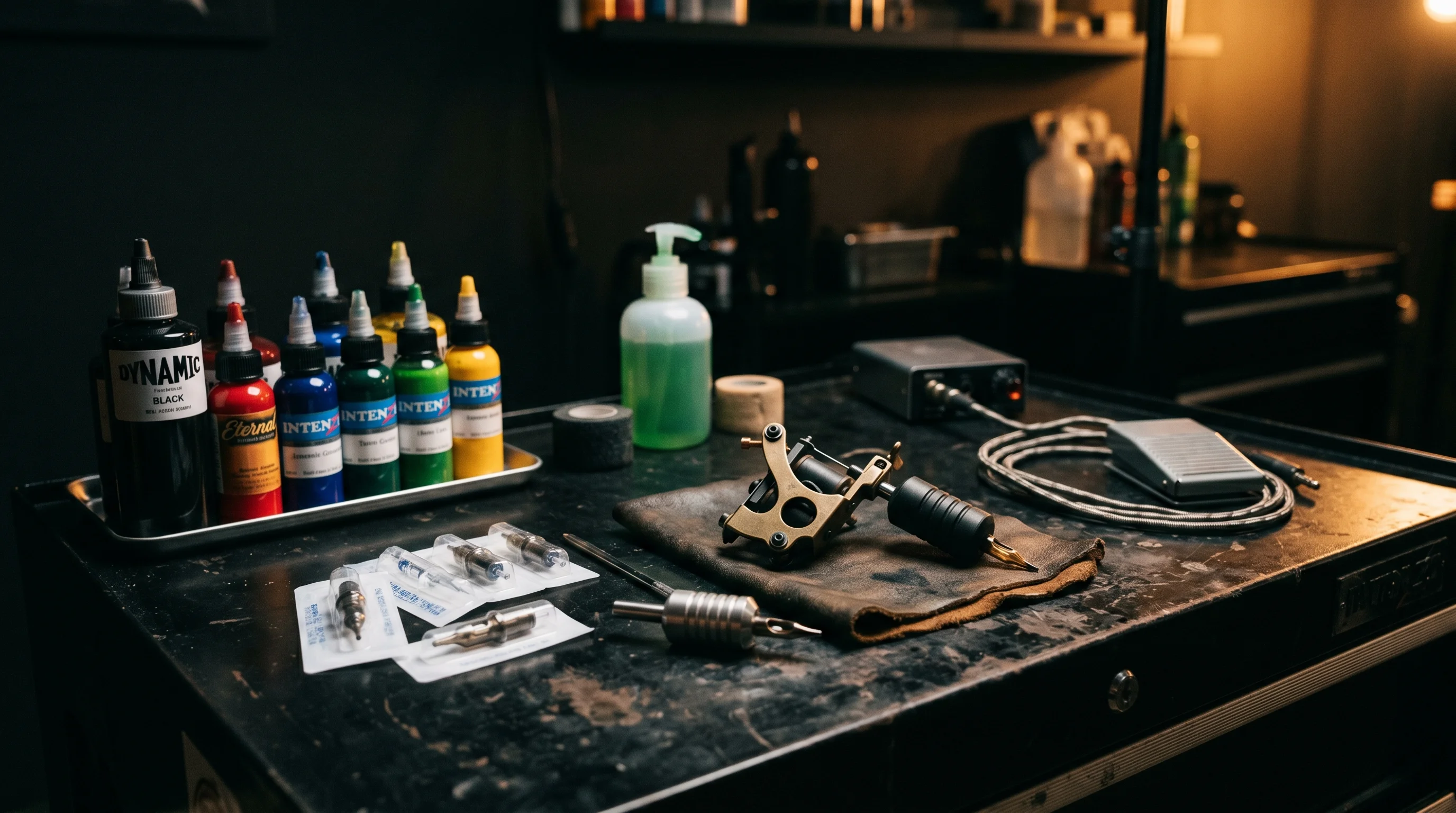
You’ve found an artist whose Instagram looks incredible. Sixty thousand followers, stunning convention pieces, linework sharp enough to read across the room. You’re ready to book.
Here’s what you’re not seeing: the tattoos they don’t post. The healed work from eighteen months ago that’s already bleeding at the edges. The flash piece that photographed flawlessly but sits patchy after a year of summer. The Tuesday afternoon session when they were on their fourth client and you were the least complex piece of the day.
Every portfolio is a curation, not a catalog. And most first-timers evaluate a tattoo artist the same way they shop for something aspirational — falling in love with the best-case result while ignoring the variables that actually determine theirs.
The short version: A great artist for someone else’s style may be wrong for yours. The right way to evaluate is by looking at healed work, consistency across pieces, and how many times they’ve done your specific style — not by how good their best piece is.
The stakes are real. Research on tattoo outcomes found that people tattooed by amateur or informal artists regret their work at a rate of 43.3% — compared to just 19.3% for those who worked with professional artists. That’s more than double. Technical quality and aging poorly rank as the third most common reason people regret their tattoos, cited by 41% of those with regret. The artist you pick is the single biggest variable you control before the needle touches your skin.
With nearly 24,000 tattoo businesses operating in the United States — a market that’s grown at nearly 11% annually since 2020 — there’s no practical reason to settle for someone who almost fits what you need.
Every Portfolio Shows Their Best Work. Your Tattoo Isn’t Their Best Day.
A curated Instagram is a highlight reel. The problem isn’t that artists post their best work — that’s rational, that’s how they book clients. The problem is that a highlight reel tells you almost nothing about consistency.
What you actually want to know: what does their average work look like? Not the piece they entered in a convention. Not the collaboration they’re most proud of. The piece they did on a Tuesday afternoon after four sessions, when you were the last appointment and the design was straightforward.
Ask to see healed work. Fresh tattoos always photograph beautifully — the ink is raised, saturated, colors pop before they’ve settled into skin. Healed tattoos show you what you’re actually buying. Lines that looked crisp on day one can blur at the edges after six months. Color fills that looked rich can turn patchy. This isn’t a criticism of any artist — healed tattoos are harder to photograph and generate less engagement. But as a client, healed work is the truth. An artist who actively posts healed results is showing you something valuable: they’re confident enough in their longevity to show it.
Ask to see more than five pieces in your specific style. Not their style in general — your specific style. If you want fine-line botanical work and they primarily post bold traditional pieces, their technical skill level doesn’t transfer cleanly to your design. Style is a practice. It requires developing specific muscle memory, understanding which details survive healing at specific scales, learning which placements hold fine linework over time. That knowledge comes from repetition in that style, not from being a good artist generally.
Style Specialization Is the Variable Most People Ignore
There are nearly 24,000 tattoo businesses in the US. You have options. Use them to find a specialist, not a generalist who can technically execute your style.
A specialist in fine-line botanical work has developed judgment that a generalist hasn’t. They know how thin a stem can go before it blows out over two years. They know which placements hold fine detail and which ones will blur it. They’ve done the piece that aged badly and adjusted. You’re not just paying for their skill — you’re paying for the hundred lessons they’ve already learned at someone else’s expense.
A generalist with strong technical ability can produce a beautiful fine-line piece. But you’re on the curve they’re still working through. With a specialist, that curve is behind them.
This matters most for technical styles: fine line, single needle, geometric blackwork, realism. For bolder styles — traditional, neo-traditional, illustrative — the tolerance for “good but not specialized” is higher, because the technique has more room for variation without affecting longevity. But even there, finding someone who has done thirty pieces in your style versus three is not a small difference.
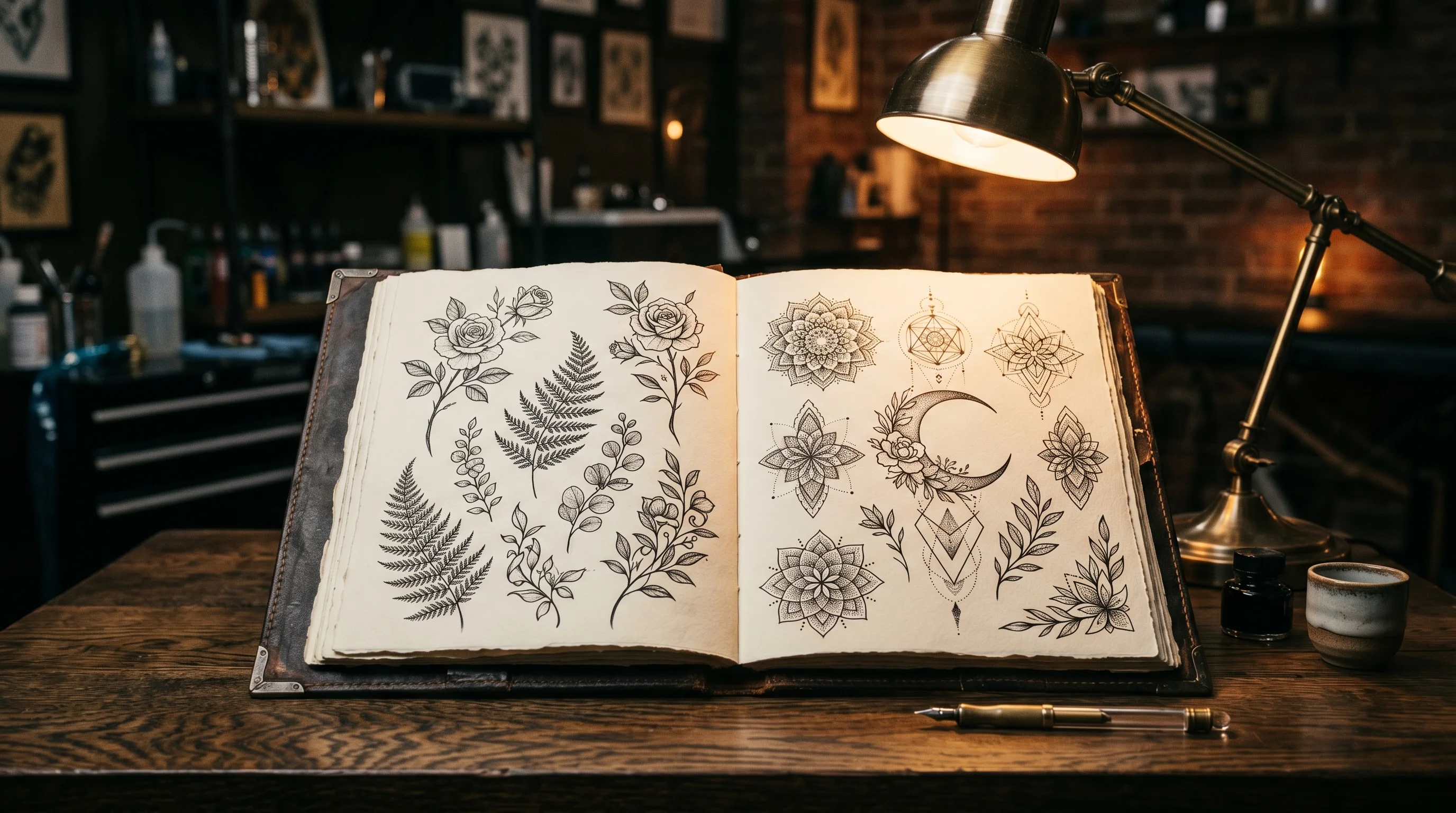
How to Read a Portfolio Like You Know What You’re Looking For
You don’t need formal training. You need to look at three things:
Line consistency. Pick any three line-heavy pieces and zoom in. Are the lines uniformly clean? Any wobble, or unintended variation in thickness? Any spot where a line ends and starts again at a slightly different width? Lines are the structural foundation — if they’re inconsistent across pieces, not just in one piece, that tells you something real.
Healed photos. Look for work that’s visibly settled into skin — edges slightly softened, ink integrated, the look of something that’s been lived in rather than just applied. If you scroll their entire portfolio and can’t find one healed piece, that’s a data point worth sitting with.
The piece closest to yours. Not their showpiece. Not their most-favorited post. Find the work that most closely resembles your actual idea — in style, subject matter, scale. Does it execute the specific thing you’re trying to get? If you’re getting a detailed portrait and their portraits are technically competent but somehow flat, that’s your answer. An artist’s red flags often show up not in their worst work but in the gap between what they post and what you actually need.
One more thing: check the ratio of their work to other people’s work in their feed. Artists who mainly repost flash or other artists’ designs, with little of their own original client work visible, are harder to evaluate — not necessarily a red flag, but not what you need to make an informed decision.
The Consultation Is Where You Actually Find Out
Book a consultation before committing to a deposit. The consultation isn’t a formality — it’s the most useful information you’ll collect.
Bring your references. Not to hand them over as a blueprint to copy, but to communicate your intent. A screenshot from Instagram is fine for inspiration — but if you have a custom design in mind (a pet, a photo, a sketch), converting it to a clean tattoo-ready design before the consultation saves significant back-and-forth and helps the artist immediately understand the direction. Watch how the artist responds to what you bring. Do they engage with what you’re trying to capture? Do they ask about the meaning, the feeling, the placement context? Or do they immediately redirect toward their preferred interpretation of your idea without explaining why?
Honest pushback is a green flag. If your design needs to be scaled up to hold its detail at your chosen placement, you want the artist to tell you that before the session. If the text is too small to survive healing, if the composition doesn’t work for the shape of your arm, if the style you’ve requested will age badly at this particular placement — that’s information. An artist who tells you this is one who cares about the result more than the booking.
A YouGov survey on tattoo regret found that overall regret rates in the US sit around 22% — but regret is sharply concentrated in impulsive decisions and poor planning. The consultation is where planning happens and where most regret is preventable.
Red flag: the artist agrees with everything you say, makes no suggestions or adaptations, and starts talking deposit before you’ve finished explaining what you want.
Green flag: they ask why you want the piece. Not because they need your permission — understanding your intent helps them execute it better. An artist who gets the meaning produces more than an artist who copies the reference.
What a Safe Studio Signals Beyond the Health Certificate
A clean, professional studio isn’t just a health requirement. It’s a proxy signal for the overall standard an artist holds themselves to.
Walk through mentally: single-use needles and cartridges opening in front of you, artist applying fresh gloves at session start and changing them if they touch anything off the work surface, barrier film fresh for your appointment, your questions about their process answered directly and without defensiveness. None of this is extraordinary — it’s baseline professional standard. But artists who maintain that baseline consistently tend to apply the same attention to their craft.
If anything feels off when you walk in — and it’s worth noticing — trust that instinct enough to ask a question. A professional artist will answer it without irritation.
The Question the Consultation Doesn’t Close
You’ve done the work. The artist’s healed portfolio is solid. They specialize in your style. The consultation went well and they gave you honest feedback on the design. There’s one anxiety this process doesn’t fully resolve: what will your specific piece look like on your specific body, at your specific placement, at your actual scale?
That’s what TattThat closes. Upload a photo, apply your design, and see exactly how it lands on your skin before you finalize anything — at your proportions, your placement, your dimensions. Walking into the final booking confirmation already knowing the design works on your body is a different conversation than hoping it will. It’s the step most people skip. It’s the one that makes everything that follows feel certain.
For more on what to expect once you’re actually in the session, the full first tattoo appointment guide covers the stencil check, the sensation, and the first 24 hours. And if you’re still calibrating how to communicate your idea to an artist, the first tattoo guide has the full framework.
See It on Your Skin Before You Commit
Upload a photo, pick a design, and see exactly how it'll look — in seconds. 2 free previews, no card required.
Try TattThat Free →