The frame most people bring to this is wrong.
“Hidden tattoo placement” gets treated as a concealment problem — a practical workaround between wanting ink and the reality of professional life. The better frame: some placements are naturally invisible in work clothes, so there’s nothing to manage at all. The tattoo doesn’t need to be hidden. It just lives somewhere that standard attire happens to cover.
The direct answer: The most reliably work-safe placements are the ribs and side body, upper back, hip and upper outer thigh, and inner upper arm. All of them disappear completely under business casual — no layering strategy, no collar check before a meeting.
These Placements Disappear Without Any Effort
Most people approaching this for the first time think about it backwards — they have a design in mind, they have a rough placement idea, and then they start calculating whether it’s visible. The cleaner approach: start with the placements that are automatically covered, then find what design fits there.
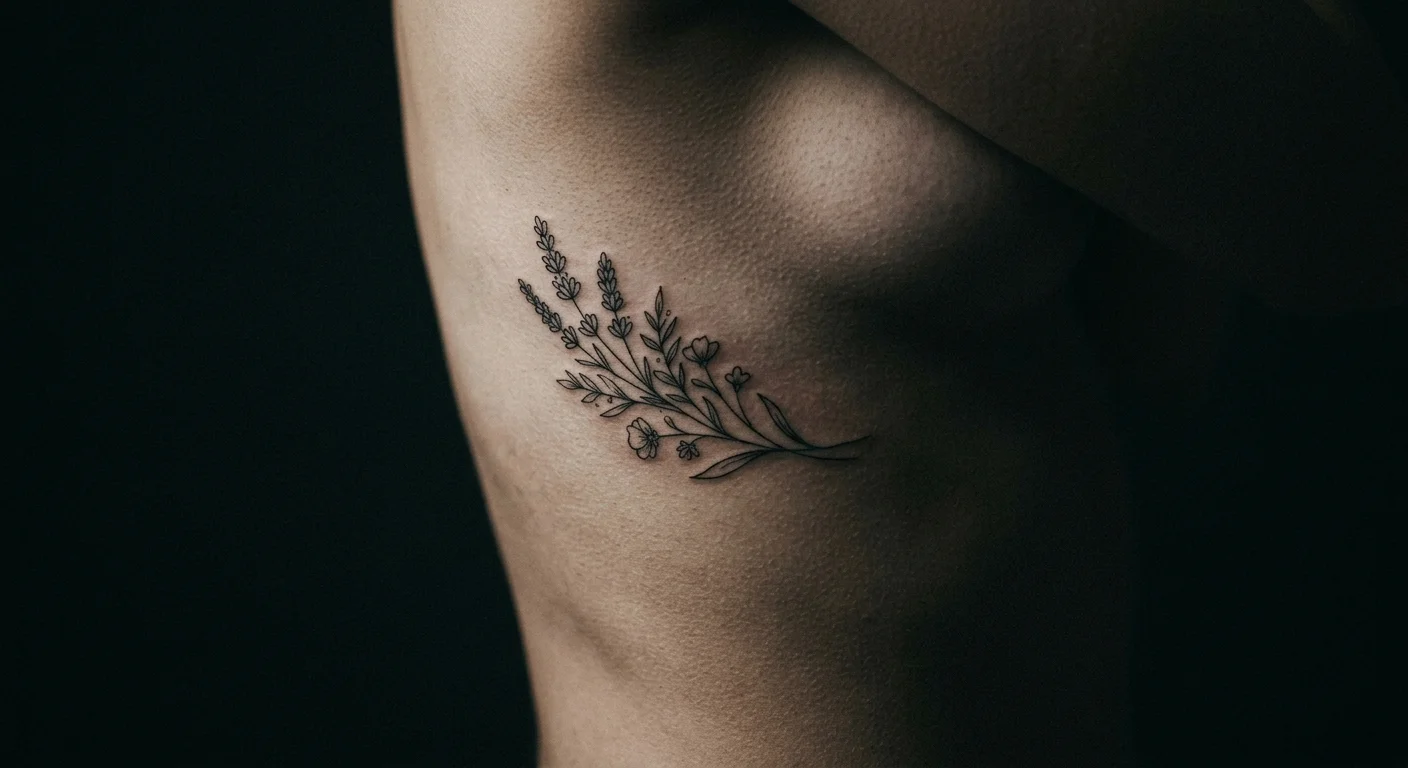
Ribs and side body. This is the most popular hidden placement for a reason. Any shirt with a torso covers it. A tank top covers it. A fitted dress covers it. The only time it’s visible is when you actively choose to show it — at the beach, at the gym, or when you want to. The canvas runs from just below the armpit down toward the hip, which gives you a long vertical space that works well for florals, meaningful text, or elongated designs.
The tradeoff is real: ribs are among the more painful placements, sitting directly over bone with minimal soft tissue cushioning. As the sternum placement guide covers, bony placements consistently produce higher pain scores than fleshy ones. But the healing is cleaner than the session suggests, and the pain ends the day the appointment does.
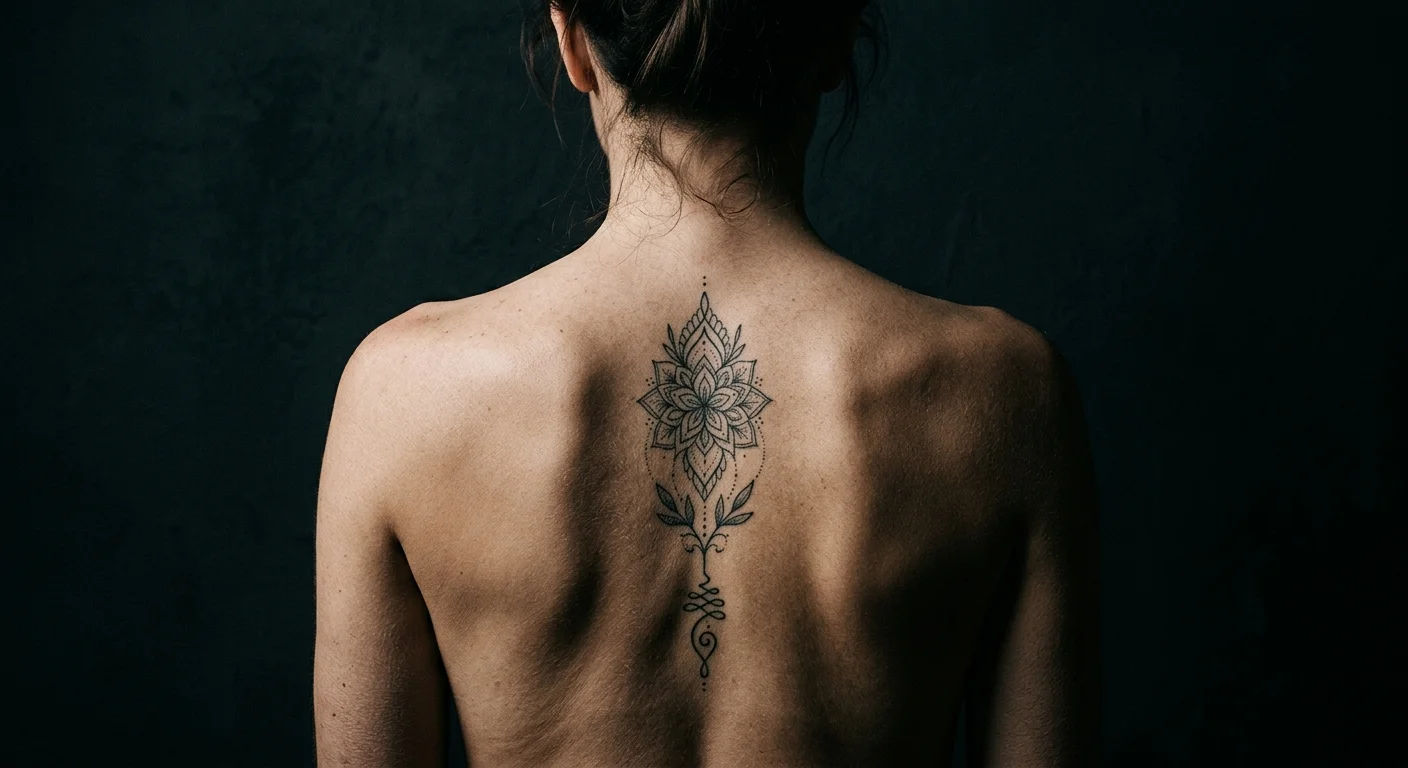
Upper back and shoulder blades. A crew neck t-shirt covers it. A blazer covers it. A button-up, a blouse, any professional top covers it. This is one of the largest available canvases on the body, and it spends almost every working hour completely hidden. The shoulder blade area specifically suits symmetrical designs, detailed singular pieces, or compositions that expand naturally across the upper back.
The one catch: it’s hard to see yourself. You need a second mirror or someone else to look at it directly. That’s a minor inconvenience given the tradeoffs — large canvas, zero professional exposure risk, good aging properties.
Hip and upper outer thigh. These placements don’t appear in hidden placement guides as often as ribs, but they’re arguably more hidden. The hip is invisible under any trouser, any skirt below mid-thigh, any dress. The upper outer thigh disappears under the same. Unless you’re wearing a bikini bottom and nothing else, these placements don’t exist at work. They also offer a generous canvas — the hip and thigh are flatter and more stable than many people expect, and they handle detailed work well. For a full breakdown of the three distinct hip zones and what designs work in each, see the hip tattoo placement guide.
Inner upper arm. This one sits in a more flexible zone. Under a short-sleeved shirt, the inner bicep faces inward and is largely covered — especially in professional settings where your arms are typically down or forward, not raised. Under a long-sleeved shirt, it’s completely invisible. It reveals naturally in casual settings (reaching for something, gesturing, going sleeveless in summer) and stays hidden in professional ones without any thought required.
Hidden Placements Also Happen to Age Better
The placements most visible at work are exactly the ones that fade fastest. It’s not a coincidence.
Research from YouGov shows 26% of employers are less likely to hire candidates with visible tattoos — the “visible” in that finding refers to placements like the forearms, wrists, hands, and neck. These are also the placements with the highest UV exposure. Forearms see sun every time you’re outside without sleeves. Wrists are exposed essentially all day. Hands get more sun than any other part of the body.
The hidden placements avoid all of this. Ribs rarely see direct sunlight. Upper back is either covered by clothing or you’re at a beach — somewhere you’re more likely to apply sunscreen. Hips and thighs are almost never exposed without deliberate choice. Less sun means slower fading, which means a tattoo that still looks sharp years longer than its visible counterparts.
Friction is the other factor. Hands, wrists, and feet see constant rubbing against surfaces, clothing, and each other. Hidden placements like ribs, upper back, and inner upper arm don’t have that problem. The ink sits more stably in skin that isn’t being worked on constantly.
Hips and thighs also rank among the lowest-regret placements in tattoo research — which lines up with the aging argument. When a placement holds up well over time and stays personally meaningful rather than constantly scrutinized by strangers, regret tends to stay low. A 2024 AARP survey of 3,076 adults found 75% of tattooed Americans are completely satisfied with their tattoos overall — private, well-aging placements are a big part of why that number is so high.
When the Placement Is Private, the Design Can Be More Personal
There’s a different kind of decision-making that comes with genuinely hidden placements.
Visible tattoos often get chosen with an audience in mind — even subconsciously. What will read well from five feet away? What makes sense without context? The outer forearm, the calf, the upper arm: these are tattoos that become part of how you’re perceived publicly, and that shapes what people choose.
Hidden placements remove that filter entirely. Nobody’s seeing your ribcage tattoo in a meeting. The design can be entirely for you — more specific, more personal, less calibrated for external legibility. That’s why hidden placements tend to carry more private meaning: a date, a phrase in a language nobody in your office speaks, imagery that would take a paragraph to explain to a stranger. It doesn’t need to be instantly readable. It needs to matter to you.
Hidden placements also allow for larger designs than people typically plan for. The ribs run from the armpit to the hip — that’s a substantial vertical canvas. The upper back between the shoulder blades handles medium to large compositions cleanly. The tattoo size guide covers how canvas size determines what detail holds over time. Hidden placements are often where people undersize because they’re thinking “small and secret,” when the canvas can actually support something much more significant.
The harder practical reality: it’s genuinely difficult to preview a tattoo on your own ribs or hip without help. You can’t hold a reference image to your side and look at it in the mirror the way you can with your forearm. The angle is wrong, the skin curves differently than you expect, and sizing is hard to judge without seeing it at scale.
That’s exactly where TattThat helps. Upload a photo of the placement you’re considering — your side, your hip, your upper back taken with a second mirror — load your design, and position it at actual scale on your actual body. What a 5-inch ribcage piece looks like versus a 3-inch one, whether the design orientation works with the curvature of your side: these questions become immediately visible instead of guesses you’re making in the chair. The placements that are hardest to visualize yourself are the ones where a preview matters most.
See It on Your Skin Before You Commit
Upload a photo, pick a design, and see exactly how it'll look — in seconds. 2 free previews, no card required.
Try TattThat Free →