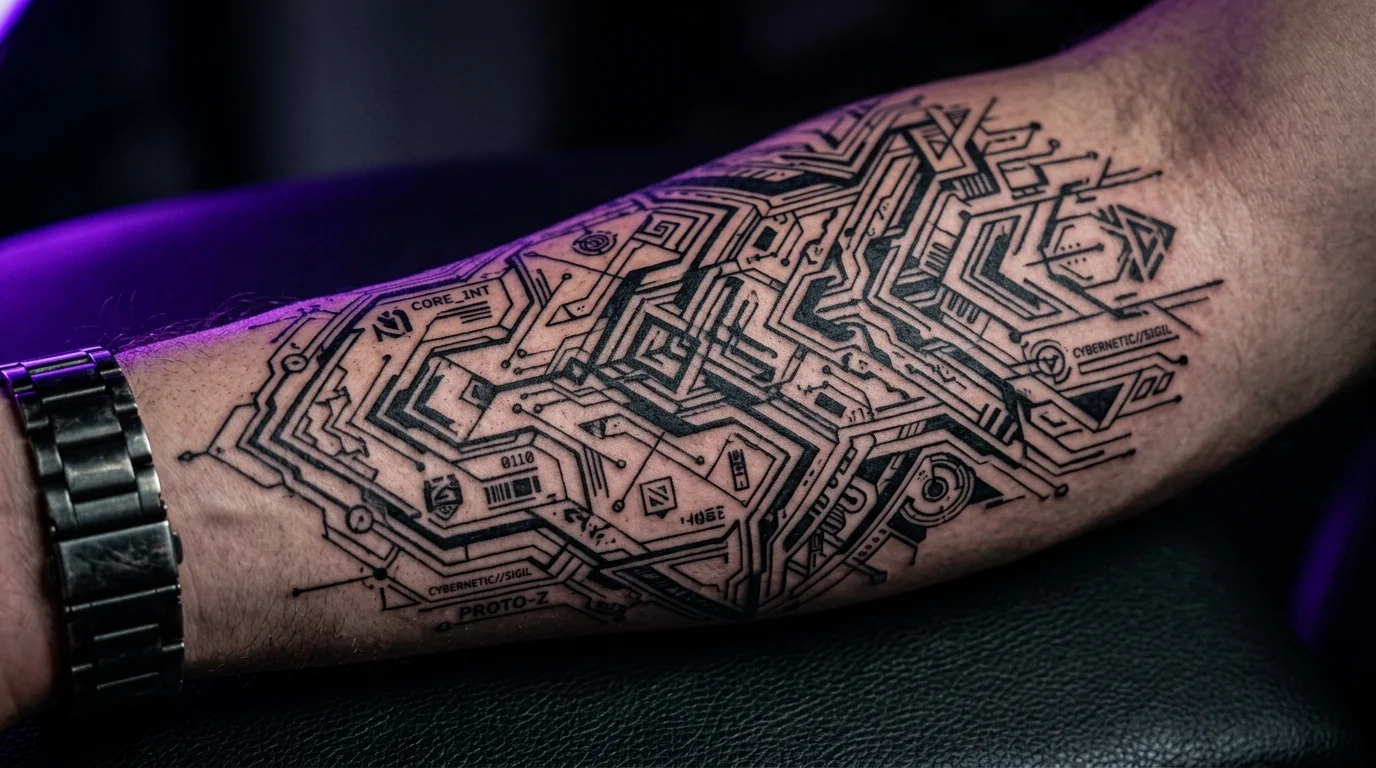
Most people encounter cybersigilism tattoos the same way: someone’s forearm in a video, and the instinct to think “what is that?” The lines are thinner than almost anything you’ve seen in ink. The shapes look like something between a rune and a circuit diagram. It reads simultaneously ancient and algorithmic.
The immediate reflex is to call it a trend. It showed up fast on feeds, it has a name that sounds invented, and it’s associated with Gen Z — three markers people use to dismiss visual movements as disposable. That reflex misses what’s actually happening with this style.
The direct answer: Cybersigilism is a blackwork tattoo aesthetic built from ultra-fine linework, sharp angular geometry, and symbolic forms derived from both digital culture and occult sigil-making traditions. It’s not tribal reinvented — the visual vocabulary is entirely different. It’s the first major tattoo style whose aesthetic language emerged natively from internet culture rather than migrating from a physical subculture into the mainstream.
The Visual Logic: What Actually Makes It Recognizably Cybersigilism
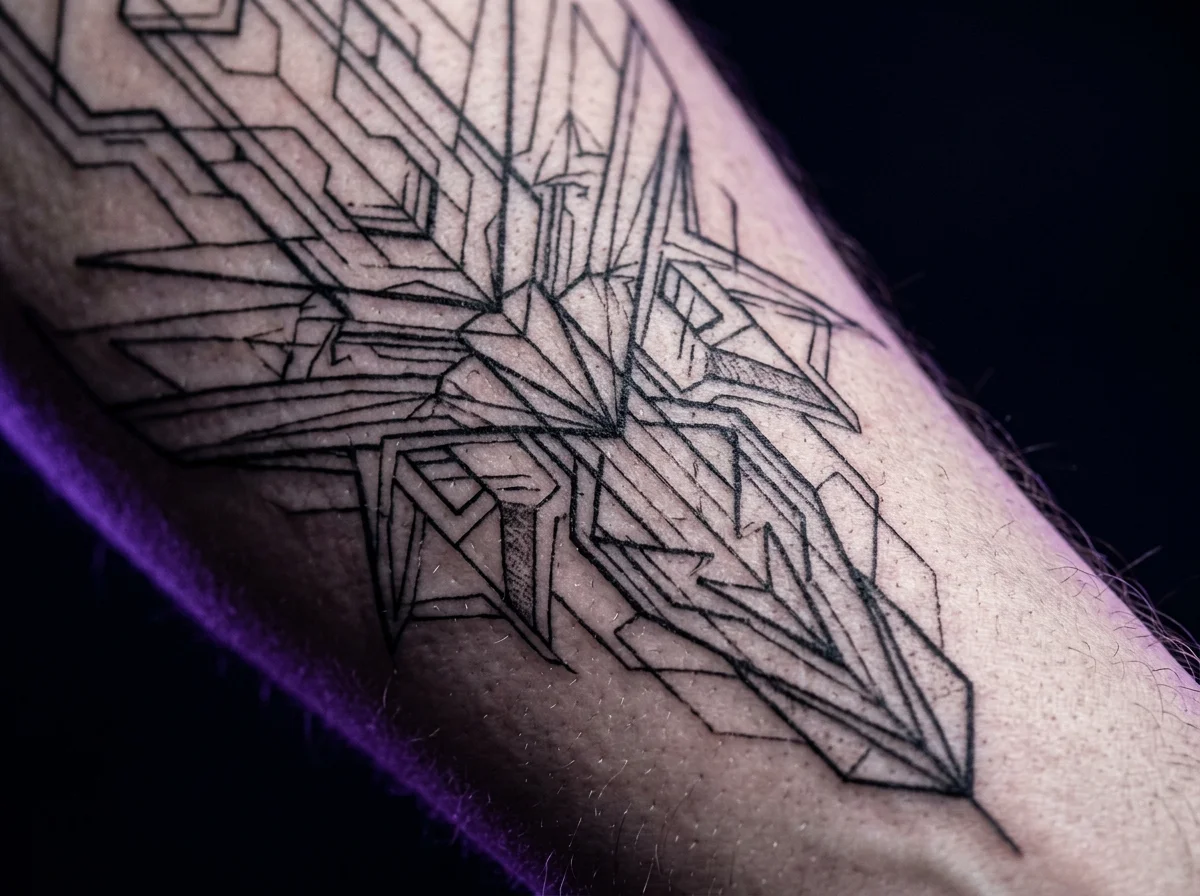
The defining element isn’t the subject matter — it’s the line weight and geometry.
Monolith Studio’s specialist in the style describes the four structural elements: lines thinner than almost any other tattoo style; sharp angles and geometric forms over curves; compositional density with layered symbolic meaning; and deliberate use of negative space as a structural component rather than empty area. Remove any of those and the piece stops reading as cybersigilism.
What this means in practice: the linework is precision-dependent in a way that most styles aren’t. A slightly heavy hand on a neo-traditional piece is forgivable. On a cybersigilism piece, line weight variation is the whole language — a line that’s twice as thick as intended is the visual equivalent of a wrong note in a precisely arranged passage. This is why artist selection matters more in this style than in most.
The imagery often incorporates what look like distorted familiar symbols — crosses, stars, anatomical forms — bent into sharp, angular versions of themselves. Common motifs include blade-like spurs, angular vascular networks, and shapes that evoke motherboard circuitry. But the specific symbols are secondary to the linework system that holds them. Cybersigilism pieces that read as generic usually have interesting imagery executed without the requisite precision in the lines themselves.
Where It Came From — and Why That Determines Whether It Lasts
The style emerged from Berlin’s underground club scene in the late 2010s, developed by artists working in DIY and underground tattoo contexts before it had a name. It draws from three sources that don’t obviously belong together: H.R. Giger’s biomechanical aesthetics, heavy metal and black metal logo design, and the visual language of early internet and Y2K digital culture — circuit diagrams, early 3D rendering, glitch aesthetics.
The name “cybersigilism” was coined by practitioners within that community, not by trend forecasters. By the early 2020s it had reached platforms, and by 2023 it had celebrity association (Billie Eilish, Grimes, Playboi Carti’s aesthetic) that pushed it into broad cultural visibility. That sequence — practitioner community first, then platform spread, then mainstream — is the pattern of styles that develop aesthetic depth before their viral moment rather than after.
Tattoo styles that arrive the other way around (trend first, vocabulary second) tend to produce a wave of poorly executed work that burns out the audience before the style matures. Cybersigilism already had years of practitioner development before most people heard of it. That foundation is what YouGov’s 2025 research documenting the broad shift toward tattoos as acceptable self-expression reflects — 76% of Americans now view tattoos as art, up from 65% in 2015, which means niche aesthetics with coherent visual logic have the audience to go mainstream without losing their core identity.
Who Actually Wears It and Why
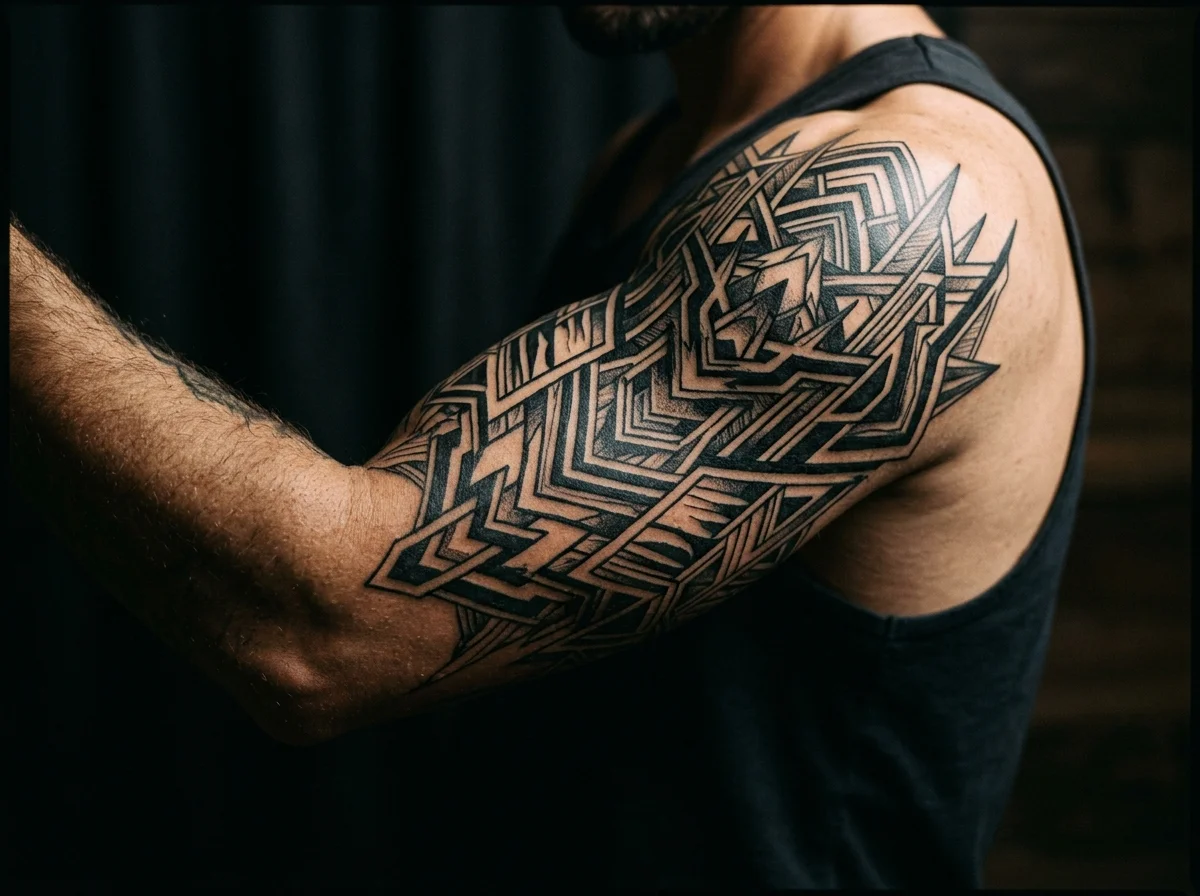
The cultural context matters here because it explains why this style generates unusually high commitment from its wearers.
Psychology Today’s research on tattoo motivation finds that identity expression is the dominant driver for deliberate tattoo choices — “my body is a book, my tattoos is my story.” Cybersigilism takes that logic further than most styles. Because the symbolism is personally encoded rather than style-prescribed, the wearer isn’t expressing an aesthetic preference so much as building a visual language specific to themselves. The design doesn’t mean cybersigilism — it means whatever the wearer built into it.
Within Gen Z communities, the style has been particularly adopted as a form of body customization that maps digital identity onto physical form — described in the practitioner community as “character customization,” the same logic used in gaming and avatar design. For trans and queer wearers specifically, it’s been adopted as a body-affirmative practice: the act of marking the physical body with symbols chosen by the self.
This isn’t background color for an article about a tattoo style — it’s the core reason cybersigilism has structural staying power. Styles worn for identity reasons age differently than styles worn for aesthetic ones. The person who got it because it was trending will evaluate it differently in five years than the person who chose it as a personal symbolic system.
Placement, Sizing, and What Your Artist Needs to Know
The ultra-fine linework that defines cybersigilism is unforgiving of poor placement decisions. The lines need a stable, flat surface to execute precisely — and they need that same surface long-term to hold without blurring.
Forearm is the most common choice, and it works because the inner and outer forearm provides a relatively flat canvas with low daily friction. The forearm placement guide covers the inner vs. outer tradeoffs in detail — for cybersigilism specifically, the outer forearm has an edge for longevity since it sees less contact with surfaces than the inner forearm.
Chest and back panels suit larger-scale cybersigilism compositions. The flat surface allows for complex geometric arrangements that would distort on curved placements, and the lower sun exposure helps the fine lines hold their definition longer.
Hands, wrists, and neck are popular in the aesthetic but technically demanding. High-movement areas and daily friction cause ultra-fine lines to blur faster than in most other body regions. If this is your first cybersigilism piece, a forearm or upper arm placement gives you a better chance of seeing the work hold its precision over years rather than months.
Sizing is less flexible than in other styles — cybersigilism can’t be effectively miniaturized. The dense linework that makes the style legible requires enough real estate to keep lines distinct. Most artists specializing in the style have a minimum size requirement for a reason. A piece that gets scaled down to fit a small placement loses the visual density that makes it read correctly. For sizing across placements, the general tattoo placement guide covers how canvas size affects what’s achievable — the same principles apply here, with stricter constraints.
Cybersigilism is one of the styles where the gap between “looks good in a reference image” and “looks right on my body” is widest. The density, the line weight, the scale — all of it reads differently on your actual forearm versus someone else’s. Before you book a session for a piece this committed, TattThat lets you place the design on a photo of your own body and see exactly how it reads on your skin, your proportions, your chosen placement. Bold styles deserve that confirmation step more than subtle ones.
See It on Your Skin Before You Commit
Upload a photo, pick a design, and see exactly how it'll look — in seconds. 2 free previews, no card required.
Try TattThat Free →